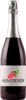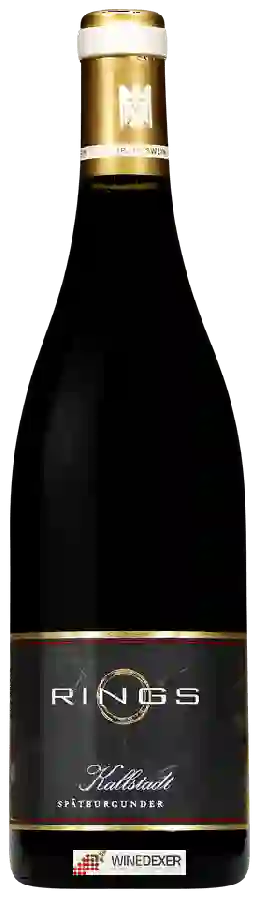
Winery RingsKallstadt Spätburgunder
 Red wine


In the mouth this red wine is a with a nice freshness.
This wine generally goes well with poultry, beef or veal.

Taste structure of the Kallstadt Spätburgunder from the Winery Rings
Light | Bold | |
Smooth | Tannic | |
Dry | Sweet | |
Soft | Acidic |
In the mouth the Kallstadt Spätburgunder of Winery Rings in the region of Pfalz is a with a nice freshness.
Wine flavors and olphactive analysis



On the nose the Kallstadt Spätburgunder of Winery Rings in the region of Pfalz often reveals types of flavors of non oak, earth or oak and sometimes also flavors of spices, red fruit or black fruit.
Food and wine pairings with Kallstadt Spätburgunder
Pairings that work perfectly with Kallstadt Spätburgunder



Original food and wine pairings with Kallstadt Spätburgunder

The Kallstadt Spätburgunder of Winery Rings matches generally quite well with dishes of beef, veal or game (deer, venison) such as recipes of quick meatloaf, atriaux en sauce or venison leg marinated in white wine and grand marnier.
Details and technical informations about Winery Rings's Kallstadt Spätburgunder.
Discover the grape variety: Kokur Bely
Structured, aromatic whites with a pale to amber-golden colour, ample palate with fresh acidity, signature aromas of citrus, white flowers, yellow fruits and mineral notes. Also as historic sweet wines. Traditional component of dry white wines from Crimea (notably Sudak) and sweet wines from Massandra, contributing to historic regional blends of the Caucasus. Indigenous white variety from Ukraine and Russia, grown mainly in Crimea and the Caucasus.
Last vintages of this wine

The best vintages of Kallstadt Spätburgunder from Winery Rings are 2017, 2016, 0, 2015
Informations about the Winery Rings
The Winery Rings is one of of the world's great estates. It offers 79 wines for sale in the of Pfalz to come and discover on site or to buy online.

The wine region of Pfalz
Fleshy, dry, fruity Riesling is the region's signature: yellow peach, apricot, ripe citrus, lovely mineral tension. Germany's largest red-wine area (40%), with silky Spätburgunder showing red fruit and spice, darker structured Dornfelder, supple Portugieser. Some rounded Pinot Blanc and Pinot Gris. A 23,640 ha vineyard along the Haardt, among Germany's warmest (>2,000 h of sun).
The word of the wine: Old vines
There are no specific regulations governing the term "vieilles vignes". After 20 to 25 years, the yields stabilize and tend to decrease, the vines are deeply rooted, and the grapes that come from them give richer, more concentrated, more sappy wines, expressing with more nuance the characteristics of their terroir. It is possible to find plots of vines that claim to be a century old.