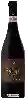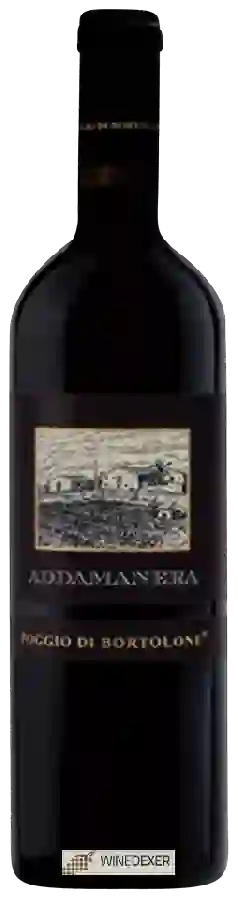
Winery Poggio di BortoloneAddamanera
 Red wine



In the mouth this red wine is a powerful.
This wine generally goes well with beef, lamb or pasta.

Taste structure of the Addamanera from the Winery Poggio di Bortolone
Light | Bold | |
Smooth | Tannic | |
Dry | Sweet | |
Soft | Acidic |
In the mouth the Addamanera of Winery Poggio di Bortolone in the region of Sicily is a powerful.
Food and wine pairings with Addamanera
Pairings that work perfectly with Addamanera



Original food and wine pairings with Addamanera
The Addamanera of Winery Poggio di Bortolone matches generally quite well with dishes of beef, pasta or lamb such as recipes of fondue vigneronne au vin rouge, pasta with neapolitan sauce and mushrooms or lamb with vermicelli.
Details and technical informations about Winery Poggio di Bortolone's Addamanera.
Discover the grape variety: Cabernet-Sauvignon
Structured, tannic reds, deeply coloured, with aromas of blackcurrant, blackberry, cedar, tobacco and graphite, underpinned by firm acidity and fine ageing potential. Cornerstone of the great Médoc estates (Pauillac, Saint-Estèphe, Saint-Julien) and signature of Napa Valley, Coonawarra and Maipo. The world's most planted red variety, a natural cross of Cabernet Franc x Sauvignon Blanc born in Bordeaux.
Last vintages of this wine
The best vintages of Addamanera from Winery Poggio di Bortolone are 2016, 2017, 0, 2013
Informations about the Winery Poggio di Bortolone
The Winery Poggio di Bortolone is one of of the world's greatest estates. It offers 10 wines for sale in the of Sicily to come and discover on site or to buy online.

The wine region of Sicily
Major qualitative renewal. Sunny, expressive reds: fleshy, spicy Nero d'Avola (black cherry, blackberry, liquorice), fine, mineral Nerello Mascalese on Etna (recalls Pinot Noir), light, crisp Frappato in Cerasuolo di Vittoria DOCG. Lively, saline whites: Catarratto, fat, iodised Grillo, taut Carricante, floral Inzolia. Amber, walnutty fortified Marsala.
The word of the wine: Pinot meunier
Cultivated in the 19th century in all the northern vineyards, this black grape variety has largely regressed since. Very present in the Marne valley, it constitutes a third of the vineyards in Champagne, alongside pinot noir and chardonnay with which it is often blended. It brings roundness and red and yellow fruit aromas to champagnes. Pinot meunier is also the dominant grape variety in red and rosé wines in the Orleans AOC and the rare Touraine-Noble-Joué, a grey wine. Syn.: meunier.