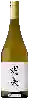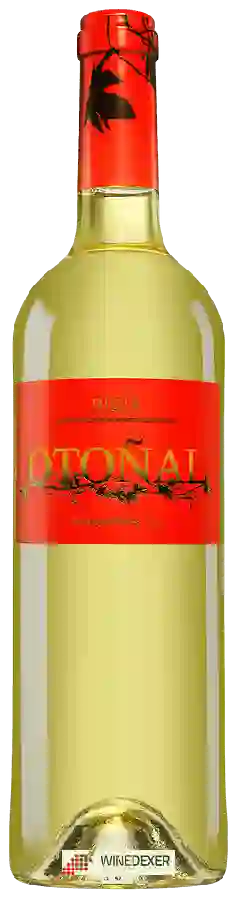
Bodegas OlarraOtoñal Rioja Blanco
 White wine



In the mouth this white wine is a powerful with a nice freshness.
This wine generally goes well with appetizers and snacks, lean fish or shellfish.
Taste structure of the Otoñal Rioja Blanco from the Bodegas Olarra
Light | Bold | |
Dry | Sweet | |
Soft | Acidic |
In the mouth the Otoñal Rioja Blanco of Bodegas Olarra in the region of Rioja is a powerful with a nice freshness.
Wine flavors and olphactive analysis




On the nose the Otoñal Rioja Blanco of Bodegas Olarra in the region of Rioja often reveals types of flavors of non oak, vegetal or oak and sometimes also flavors of citrus fruit.
Food and wine pairings with Otoñal Rioja Blanco
Pairings that work perfectly with Otoñal Rioja Blanco



Original food and wine pairings with Otoñal Rioja Blanco

The Otoñal Rioja Blanco of Bodegas Olarra matches generally quite well with dishes of shellfish, appetizers and snacks or lean fish such as recipes of cuttlefish rust from my grandmother in sète, small croissants with smoked salmon (toast) or cod fillet with shallots and mustard.
Details and technical informations about Bodegas Olarra's Otoñal Rioja Blanco.
Discover the grape variety: Cabernet_Dorio
Intraspecific crossing between the limberger and the dornfelder realized in 1971 by Bernard Hill of the Research Institute of Weinsberg in Germany. It can be found in Germany, Belgium and Switzerland, but is little known in France. Note that the cabernet-dorsa has the same parents.
Last vintages of this wine
The best vintages of Otoñal Rioja Blanco from Bodegas Olarra are 2015, 2016, 0, 2013
Informations about the Bodegas Olarra
The Bodegas Olarra is one of of the world's great estates. It offers 96 wines for sale in the of Rioja to come and discover on site or to buy online.

The wine region of Rioja
Rioja, in northern Spain, is best known for its berry-flavored, barrel-aged red wines made from Tempranillo and Garnacha. It is probably the leading wine region in Spain. It is certainly the most famous, rivaling only Jerez. The Vineyards follow the course of the Ebro for a hundred kilometres between the towns of Haro and Alfaro.
The word of the wine: Tanin
A natural compound contained in the skin of the grape, the seed or the woody part of the bunch, the stalk. The maceration of red wines allows the extraction of tannins, which give the texture, the solidity and also the mellowness when the tannins are "ripe". The winemaker seeks above all to extract the tannins from the skin, the ripest and most noble. The tannins of the seed or stalk, which are "greener", especially in average years, give the wine hardness and astringency. The wines of Bordeaux (based on Cabernet and Merlot) are full of tannins, those of Burgundy much less so, with Pinot Noir containing little.