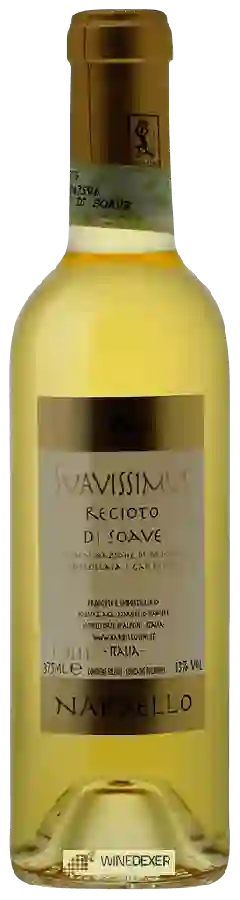
Winery NardelloSuavissimus Recioto di Saove
 Sweet wine


This wine generally goes well with
Details and technical informations about Winery Nardello's Suavissimus Recioto di Saove.
Discover the grape variety: Garganega
Very old vine cultivated in Italy, in Sicily it would carry the name of grecanico dorato and in Spain would be the malvasia mauresa... . It can be found in the United States, but in France it is almost unknown. It should be noted that its bunches resemble somewhat those of the ugni blanc or trebbiano toscano and it would be related to the verdicchio blanco.
Last vintages of this wine
The best vintages of Suavissimus Recioto di Saove from Winery Nardello are 2014, 0, 2011, 2010
Informations about the Winery Nardello
The Winery Nardello is one of of the world's greatest estates. It offers 10 wines for sale in the of Recioto di Soave to come and discover on site or to buy online.

The wine region of Recioto di Soave
The wine region of Recioto di Soave is located in the region of Soave of Vénétie of Italy. Wineries and vineyards like the Domaine Anselmi or the Domaine Roccolo Grassi produce mainly wines sweet, sparkling and white. The most planted grape varieties in the region of Recioto di Soave are Garganega et Chardonnay, they are then used in wines in blends or as a single variety. On the nose of Recioto di Soave often reveals types of flavors of non oak, earth or microbio and sometimes also flavors of oak, tree fruit or spices.
The wine region of Veneto
Veneto is an important and growing wine region in northeastern Italy. Veneto is administratively Part of the Triveneto area, aLong with its smaller neighbors, Trentino-Alto Adige and Friuli-Venezia Giulia. In terms of geography, culture and wine styles, it represents a transition from the Alpine and Germanic-Slavic end of Italy to the warmer, drier, more Roman lands to the South. Veneto is slightly smaller than the other major Italian wine regions - Piedmont, Tuscany, Lombardy, Puglia and Sicily - but it produces more wine than any of them.
The word of the wine: Imperial
Bottle with a capacity of 6 liters (synonym of mathusalem).