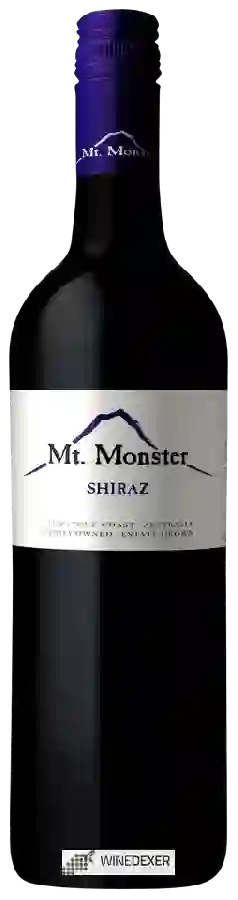
Winery Mt. MonsterShiraz
 Red wine



In the mouth this red wine is a powerful with a nice balance between acidity and tannins.
This wine generally goes well with poultry, beef or game (deer, venison).
Taste structure of the Shiraz from the Winery Mt. Monster
Light | Bold | |
Smooth | Tannic | |
Dry | Sweet | |
Soft | Acidic |
In the mouth the Shiraz of Winery Mt. Monster in the region of Australie du Sud is a powerful with a nice balance between acidity and tannins.
Wine flavors and olphactive analysis




On the nose the Shiraz of Winery Mt. Monster in the region of Australie du Sud often reveals types of flavors of cherry, oaky or smoke and sometimes also flavors of blackberry, plum or leather.
Food and wine pairings with Shiraz
Pairings that work perfectly with Shiraz



Original food and wine pairings with Shiraz

The Shiraz of Winery Mt. Monster matches generally quite well with dishes of beef, lamb or game (deer, venison) such as recipes of ramen burger, leg of lamb bravado in the oven or duck breast with honey, potato and onion with garlic.
Details and technical informations about Winery Mt. Monster's Shiraz.
Discover the grape variety: Moscato
Last vintages of this wine
The best vintages of Shiraz from Winery Mt. Monster are 2017, 2008, 2011, 2013 and 2012.
Informations about the Winery Mt. Monster
The Winery Mt. Monster is one of of the world's greatest estates. It offers 5 wines for sale in the of Limestone Coast to come and discover on site or to buy online.

The wine region of Limestone Coast
Cool-climate GI of south-eastern Australia, red terra rossa over white limestone. Coonawarra's signature Cabernet Sauvignon: classic reds with signature notes of pure blackcurrant, eucalyptus, fresh mint, cedar and graphite, firm tannins and long ageing potential — a world benchmark. Also spicy peppery Shiraz, round Merlot. Precise Chardonnay whites (citrus, hazelnut), taut Riesling (lemon, kerosene).
The wine region of Australie du Sud
Cradle of the great Australian Shiraz: powerful, sun-drenched reds with notes of blackberry, candied plum, pepper, chocolate and eucalyptus, ample tannins and vibrant fruit (Barossa, McLaren Vale). Firm, minty Cabernet Sauvignon on Coonawarra (terra rossa). Dry, lemony Riesling from Clare and Eden Valley, straight and taut. Fresh Sauvignon and Chardonnay from Adelaide Hills.
The word of the wine: Grand Cru
In Burgundy, the fourth and final level of classification (above the regional, communal and premier cru appellations), designating the wines produced on delimited plots of land (the climats) whose name alone constitutes the appellation. The climats classified as Grand Cru are 32 in the Côte d'Or plus one in Chablis which is divided into 7 distinct climats. Representing barely 1.5% of the production, the Grand Crus are the aristocracy of Burgundy wines.