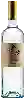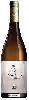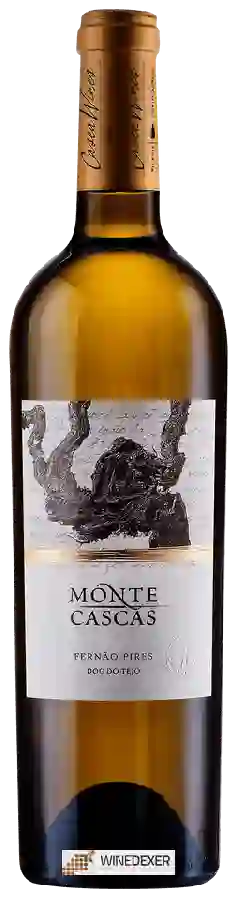
Winery Monte CascasFernão Pires
 White wine


In the mouth this white wine is a powerful.
This wine generally goes well with pork, lean fish or shellfish.
Taste structure of the Fernão Pires from the Winery Monte Cascas
Light | Bold | |
Dry | Sweet | |
Soft | Acidic |
In the mouth the Fernão Pires of Winery Monte Cascas in the region of Tejo is a powerful.
Wine flavors and olphactive analysis

Food and wine pairings with Fernão Pires
Pairings that work perfectly with Fernão Pires



Original food and wine pairings with Fernão Pires

The Fernão Pires of Winery Monte Cascas matches generally quite well with dishes of pasta, pork or shellfish such as recipes of pasta with crispy parma ham, gratin of fresh chard (green and ribs) or traditional tunisian couscous.
Details and technical informations about Winery Monte Cascas's Fernão Pires.
Discover the grape variety: Fernao Pires
In Portugal, it is one of the most planted white grape varieties, and we have found it to be very similar to the torrontés grown in Spain (Galicia). It can be found in Australia and South Africa, but is almost unknown in France.
Last vintages of this wine
The best vintages of Fernão Pires from Winery Monte Cascas are 2011, 0, 2013
Informations about the Winery Monte Cascas
The Winery Monte Cascas is one of of the world's great estates. It offers 28 wines for sale in the of Tejo to come and discover on site or to buy online.

The wine region of Tejo
Tejo is a wine region in CentralPortugal which covers the same area as the Ribatejo province, just inland from the major city of Lisbon. The wine appellation's name was changed from Ribatejo in 2009. The entire region may use the Tejo VR (Vinho Regional) designation, similar to the French IGP/Vin de Pays, while some areas produce wines labeled with the higher-level Do Tejo DOC (Denominação de Origem Controlada). A Warm, Dry area, it is also Portugal's only landlocked region – although it is influenced considerably by the Tejo river.
The word of the wine: Presses
The juice that results from pressing the grapes after fermentation. At the end of the maceration, the vats are emptied, the first juice obtained is called the free-run wine and the marc remaining at the bottom of the vat is then pressed to give the press wine. We say more quickly "the presses". Their quality varies according to the vintage and the maceration. A too vigorous extraction releases the tannins of pips and the wine of press can then prove to be very astringent. Often the winemaker raises it separately, deciding later whether or not to incorporate it totally or partially into the grand vin.