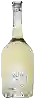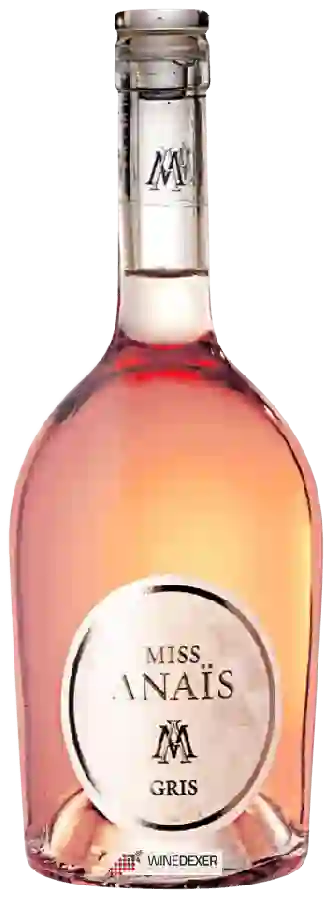
Winery Miss AnaïsGris
 Pink wine


In the mouth this pink wine is a with a nice freshness.
This wine generally goes well with vegetarian, appetizers and snacks or lean fish.

Taste structure of the Gris from the Winery Miss Anaïs
Light | Bold | |
Dry | Sweet | |
Soft | Acidic |
In the mouth the Gris of Winery Miss Anaïs in the region of Pays d'Oc is a with a nice freshness.
Wine flavors and olphactive analysis


On the nose the Gris of Winery Miss Anaïs in the region of Pays d'Oc often reveals types of flavors of tree fruit, citrus fruit or red fruit.
Food and wine pairings with Gris
Pairings that work perfectly with Gris



Original food and wine pairings with Gris


The Gris of Winery Miss Anaïs matches generally quite well with dishes of vegetarian, pasta or appetizers and snacks such as recipes of quiche lorraine, pasta with 4 cheese sauce or hummus.
Details and technical informations about Winery Miss Anaïs's Gris.
Discover the grape variety: Grenache Gris
Structured and rich whites and rosés with a pale salmon or golden robe, full mouthfeel and moderate acidity, with aromas of yellow fruits (pear, peach), candied citrus, white flowers, fennel, garrigue and schist mineral notes. Good ageing potential. Star of the great identity whites of Roussillon (Côtes du Roussillon AOC, Collioure AOC) on schist soils. A grey-skinned mutation of the Aragonese Grenache Noir.
Last vintages of this wine

The best vintages of Gris from Winery Miss Anaïs are 2021, 2022, 2018, 0 and 2019.
Informations about the Winery Miss Anaïs
The Winery Miss Anaïs is one of of the world's greatest estates. It offers 6 wines for sale in the of Pays d'Oc to come and discover on site or to buy online.

The wine region of Pays d'Oc
The single-grape IGP par excellence: modern, accessible, frank and fruity wines, the popular signature of the Midi. Spicy Syrah reds (pepper, blackberry), round Merlot, structured Cabernet, generous Grenache, supple Cinsault. Crisp, tangy rosés. Opulent Chardonnay whites, lively Sauvignon, floral, apricoty Viognier.
The word of the wine: Serious
A Bordeaux term for small pebbles from the Pyrenees, eroded, rounded and transported by the Garonne to Aquitaine. They are mainly found on the left bank in the area.... known as the Graves, and further downstream in the Médoc. By extension, gravel is found in other regions, brought by other rivers or even glaciers.