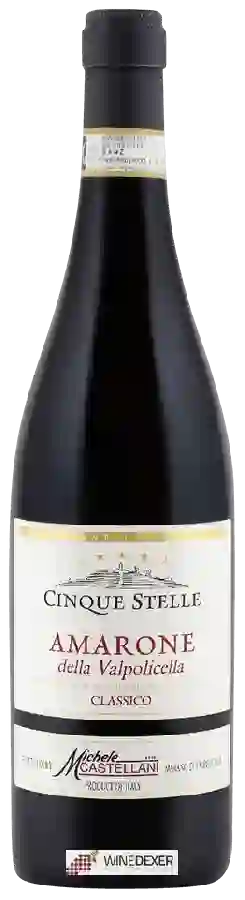
Winery Castellani MicheleCollezione Ca' Del Pipa Cinque Stelle Amarone della Valpolicella Classico
 Red wine


In the mouth this red wine is a powerful mainly marked by the residual sugar.
This wine generally goes well with blue cheese, beef or game (deer, venison).
The Collezione Ca' Del Pipa Cinque Stelle Amarone della Valpolicella Classico of the Winery Castellani Michele is in the top 40 of wines of Amarone della Valpolicella Classico.
Taste structure of the Collezione Ca' Del Pipa Cinque Stelle Amarone della Valpolicella Classico from the Winery Castellani Michele
Light | Bold | |
Smooth | Tannic | |
Dry | Sweet | |
Soft | Acidic |
In the mouth the Collezione Ca' Del Pipa Cinque Stelle Amarone della Valpolicella Classico of Winery Castellani Michele in the region of Veneto is a powerful mainly marked by the residual sugar.
Wine flavors and olphactive analysis





On the nose the Collezione Ca' Del Pipa Cinque Stelle Amarone della Valpolicella Classico of Winery Castellani Michele in the region of Veneto often reveals types of flavors of non oak, earth or microbio and sometimes also flavors of oak, spices or red fruit.
Food and wine pairings with Collezione Ca' Del Pipa Cinque Stelle Amarone della Valpolicella Classico
Pairings that work perfectly with Collezione Ca' Del Pipa Cinque Stelle Amarone della Valpolicella Classico



Original food and wine pairings with Collezione Ca' Del Pipa Cinque Stelle Amarone della Valpolicella Classico

The Collezione Ca' Del Pipa Cinque Stelle Amarone della Valpolicella Classico of Winery Castellani Michele matches generally quite well with dishes of beef, lamb or game (deer, venison) such as recipes of venison leg in casserole, pumpkin parmentier hash or potjevleesch.
Details and technical informations about Winery Castellani Michele's Collezione Ca' Del Pipa Cinque Stelle Amarone della Valpolicella Classico.
Discover the grape variety: Chardonnay
The white Chardonnay is a grape variety that originated in France (Burgundy). It produces a variety of grape specially used for wine making. It is rare to find this grape to eat on our tables. This variety of grape is characterized by small bunches, and small grapes. White Chardonnay can be found in many vineyards: South West, Burgundy, Jura, Languedoc & Roussillon, Cognac, Bordeaux, Beaujolais, Savoie & Bugey, Loire Valley, Champagne, Rhone Valley, Armagnac, Lorraine, Alsace, Provence & Corsica.
Last vintages of this wine

The best vintages of Collezione Ca' Del Pipa Cinque Stelle Amarone della Valpolicella Classico from Winery Castellani Michele are 2003, 2014, 2010, 2005 and 2015.
Informations about the Winery Castellani Michele
The Winery Castellani Michele is one of of the world's greatest estates. It offers 20 wines for sale in the of Amarone della Valpolicella Classico to come and discover on site or to buy online.

The wine region of Amarone della Valpolicella Classico
The wine region of Amarone della Valpolicella Classico is located in the region of Amarone della Valpolicella of Vénétie of Italy. Wineries and vineyards like the Domaine Quintarelli Giuseppe or the Domaine Zýmē produce mainly wines red. The most planted grape varieties in the region of Amarone della Valpolicella Classico are Rondinella, Corvina and Molinara, they are then used in wines in blends or as a single variety. On the nose of Amarone della Valpolicella Classico often reveals types of flavors of cherry, celery or baking spice and sometimes also flavors of espresso, black licorice or molasses.
The wine region of Veneto
Veneto is an important and growing wine region in northeastern Italy. Veneto is administratively Part of the Triveneto area, aLong with its smaller neighbors, Trentino-Alto Adige and Friuli-Venezia Giulia. In terms of geography, culture and wine styles, it represents a transition from the Alpine and Germanic-Slavic end of Italy to the warmer, drier, more Roman lands to the South. Veneto is slightly smaller than the other major Italian wine regions - Piedmont, Tuscany, Lombardy, Puglia and Sicily - but it produces more wine than any of them.
The word of the wine: Tartar (deposit)
White, chalky deposits that occur as a result of precipitation inside bottles and are often considered by consumers as a defect. They are in fact tartaric salts formed by tartaric acid, potassium and calcium naturally present in the wine. This deposit does not alter the quality of the wine and can be eliminated by a simple decanting.