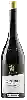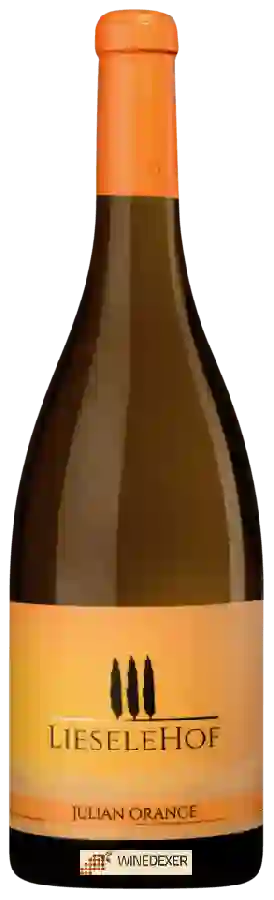
Winery LieselehofJulian Orange
 White wine


In the mouth this white wine is a powerful with a nice freshness.
This wine generally goes well with lean fish, shellfish or mature and hard cheese.
Taste structure of the Julian Orange from the Winery Lieselehof
Light | Bold | |
Dry | Sweet | |
Soft | Acidic |
In the mouth the Julian Orange of Winery Lieselehof in the region of Trentino-Alto-Adige is a powerful with a nice freshness.
Food and wine pairings with Julian Orange
Pairings that work perfectly with Julian Orange



Original food and wine pairings with Julian Orange


The Julian Orange of Winery Lieselehof matches generally quite well with dishes of pasta, shellfish or mature and hard cheese such as recipes of shrimp marinade, fish curry à la reunion or beetroot and potato gratin.
Details and technical informations about Winery Lieselehof's Julian Orange.
Discover the grape variety: Bronner
An interspecific cross between merzling and rondo obtained in 1975 by Norbert Becker of the Freiburg Research Institute in Germany. It has the particularity of having only one gene for resistance to mildew and powdery mildew. However, the I.N.R.A. Bordeaux Sciences Agro has since noted a loss of efficiency on mildew due to a bypass. It can be found in Denmark, the Netherlands, Germany, Belgium, Italy, England, etc. It is not very widespread today and is almost unknown in France. It should not be confused with another variety of the same name, which comes from a Pinot Blanc seedling, also obtained in Germany by Johann Philipp Bronner.
Last vintages of this wine
The best vintages of Julian Orange from Winery Lieselehof are 0, 2015
Informations about the Winery Lieselehof
The Winery Lieselehof is one of of the world's greatest estates. It offers 12 wines for sale in the of Trentino-Alto-Adige to come and discover on site or to buy online.

The wine region of Trentino-Alto-Adige
Italy's northernmost alpine vineyard, two identities. Aromatic, precise whites are the stars: signature opulent Gewurztraminer (lychee, rose, spice), ample Pinot Grigio, mineral Pinot Bianco, lively high-altitude Muller-Thurgau. Native reds: dense fruity Teroldego (blackberry, violet), deep Lagrein with plum and chocolate notes, light crunchy Schiava, spicy Marzemino. Trento DOC Metodo Classico sparklers.
The word of the wine: Tartar (deposit)
White, chalky deposits that occur as a result of precipitation inside bottles and are often considered by consumers as a defect. They are in fact tartaric salts formed by tartaric acid, potassium and calcium naturally present in the wine. This deposit does not alter the quality of the wine and can be eliminated by a simple decanting.