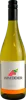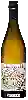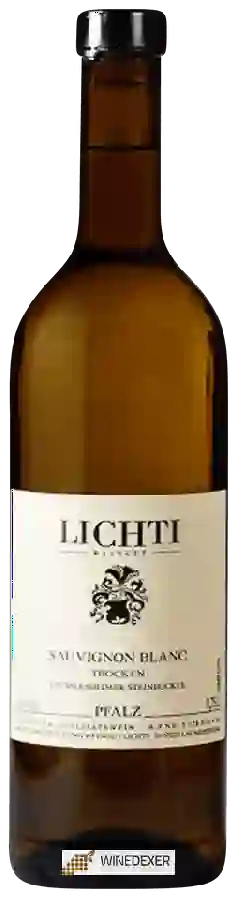
Winery LichtiLaumersheimer Steinbuckel Sauvignon Blanc Trocken
 White wine


In the mouth this white wine is a with a nice freshness.
This wine generally goes well with vegetarian, shellfish or goat cheese.
Taste structure of the Laumersheimer Steinbuckel Sauvignon Blanc Trocken from the Winery Lichti
Light | Bold | |
Dry | Sweet | |
Soft | Acidic |
In the mouth the Laumersheimer Steinbuckel Sauvignon Blanc Trocken of Winery Lichti in the region of Pfalz is a with a nice freshness.
Food and wine pairings with Laumersheimer Steinbuckel Sauvignon Blanc Trocken
Pairings that work perfectly with Laumersheimer Steinbuckel Sauvignon Blanc Trocken


Original food and wine pairings with Laumersheimer Steinbuckel Sauvignon Blanc Trocken
The Laumersheimer Steinbuckel Sauvignon Blanc Trocken of Winery Lichti matches generally quite well with dishes of shellfish, vegetarian or goat cheese such as recipes of flambéed prawns, summer tuna quiche or customized tuna pie.
Details and technical informations about Winery Lichti's Laumersheimer Steinbuckel Sauvignon Blanc Trocken.
Discover the grape variety: Chancellor
Cross between 5163 Seibel (2 Gaillard x 2510 Seibel) and 880 Seibel (28112 Couderc x 2003 Seibel) obtained by Albert Seibel (1844-1936). It was the first direct-producing hybrid cultivated in France and has now practically disappeared. It can still be found in a few old vines in the form of isolated strains. It can be found in the United States (New York, etc.) and in Canada, where it is part of the grape varieties grown on a large number of vineyards.
Last vintages of this wine
The best vintages of Laumersheimer Steinbuckel Sauvignon Blanc Trocken from Winery Lichti are 0
Informations about the Winery Lichti
The Winery Lichti is one of of the world's greatest estates. It offers 30 wines for sale in the of Pfalz to come and discover on site or to buy online.

The wine region of Pfalz
Pfalz is a key wine producing region in western Germany, located between the Rhein/Rhine river and the low-lying Haardt mountain range (a natural continuation of the Alsatian Vosges). It covers a rectangle of land 45 miles (75km) Long and 15 miles (25km) wide. To the NorthLiesRheinhessen; to the South, the French border and Alsace. In terms of both quality and quantity, Pfalz is one of Germany's most important regions, and one which shows great promise for the future.
The word of the wine: Yeast
Micro-organisms at the base of all fermentative processes. A wide variety of yeasts live and thrive naturally in the vineyard, provided that treatments do not destroy them. Unfortunately, their replacement by laboratory-selected yeasts is often the order of the day and contributes to the standardization of the wine. Yeasts are indeed involved in the development of certain aromas.