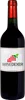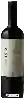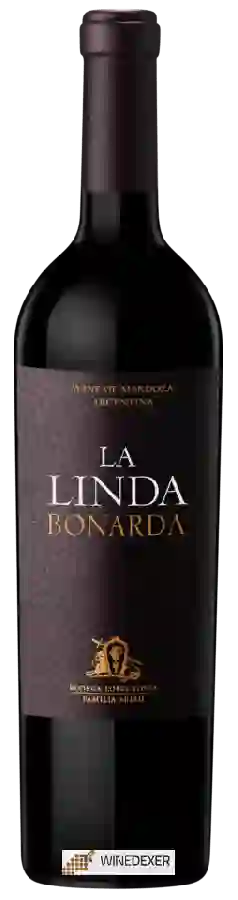
Winery La LindaBonarda
 Red wine



In the mouth this red wine is a powerful with a nice freshness.
This wine generally goes well with pork, poultry or veal.

Taste structure of the Bonarda from the Winery La Linda
Light | Bold | |
Smooth | Tannic | |
Dry | Sweet | |
Soft | Acidic |
In the mouth the Bonarda of Winery La Linda in the region of Mendoza is a powerful with a nice freshness.
Wine flavors and olphactive analysis






On the nose the Bonarda of Winery La Linda in the region of Mendoza often reveals types of flavors of cream, cherry or oaky and sometimes also flavors of minerality, red fruit or tobacco.
Food and wine pairings with Bonarda
Pairings that work perfectly with Bonarda



Original food and wine pairings with Bonarda

The Bonarda of Winery La Linda matches generally quite well with dishes of veal, pork or game (deer, venison) such as recipes of flights in the wind à la provençale, ham and cheese cake or deer stew.
Details and technical informations about Winery La Linda's Bonarda.
Discover the grape variety: Valérien
Simple, fresh dry whites with a pale golden robe, supple palate with moderate acidity, showing understated citrus and white flower aromas. Discreet rustic southern profile. Nearly extinct, preserved in INRAE variety collections for its heritage value, it reflects the pre-phylloxera ampelographic diversity of south-eastern France. Rare French white variety, formerly grown in the south-east.
Last vintages of this wine
The best vintages of Bonarda from Winery La Linda are 2019, 2017, 2016, 2018 and 2015.
Informations about the Winery La Linda
The Winery La Linda is one of of the world's greatest estates. It offers 28 wines for sale in the of Mendoza to come and discover on site or to buy online.

The wine region of Mendoza
World capital of Malbec: powerful, deep reds with blackberry, plum, violet and sweet spice, round tannins and vivid fruit. Also firm Cabernet Sauvignon, supple, juicy Bonarda, aromatic floral white Torrontés. High-altitude vineyards (800-1,700 m) at the foot of the Andes, dry continental climate irrigated by glacial waters. ~80% of Argentine output across 150,000 ha.
The word of the wine: Licking
Operation consisting in sanitizing a barrel by introducing a wick of ignited sulphur which produces a release of sulphurous gas.