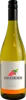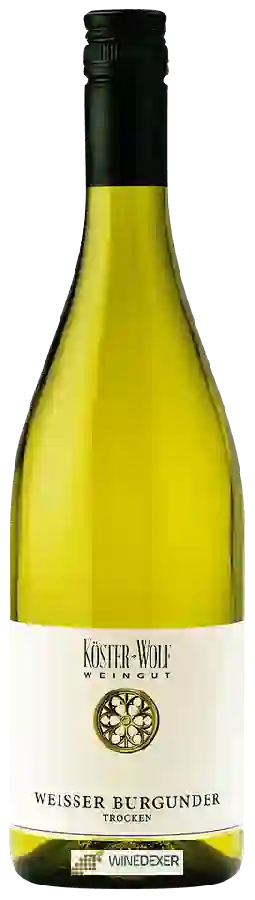
Winery Köster-WolfWeisser Burgunder Trocken
 White wine



In the mouth this white wine is a with a nice freshness.
This wine generally goes well with rich fish (salmon, tuna etc), shellfish or mild and soft cheese.
Taste structure of the Weisser Burgunder Trocken from the Winery Köster-Wolf
Light | Bold | |
Dry | Sweet | |
Soft | Acidic |
In the mouth the Weisser Burgunder Trocken of Winery Köster-Wolf in the region of Rheinhessen is a with a nice freshness.
Food and wine pairings with Weisser Burgunder Trocken
Pairings that work perfectly with Weisser Burgunder Trocken



Original food and wine pairings with Weisser Burgunder Trocken

The Weisser Burgunder Trocken of Winery Köster-Wolf matches generally quite well with dishes of rich fish (salmon, tuna etc), shellfish or mild and soft cheese such as recipes of papillotes of simple salmon steaks, spaghetti with shrimp and cream or gourmet tartiflette (pan-fried).
Details and technical informations about Winery Köster-Wolf's Weisser Burgunder Trocken.
Discover the grape variety: Malbec
Malbec, a high-yielding red grape variety, produces tannic and colourful wines. It is produced in different wine-growing regions and changes its name according to the grape variety. Called Auxerrois in Cahors, Malbec in Bordeaux, it is also known as Côt. 6,000 hectares of the Malbec grape are grown in France (in decline since the 1950s). Malbec is also very successful in Argentina. The country has become the world's leading producer of Malbec and offers wines with great potential.
Last vintages of this wine
The best vintages of Weisser Burgunder Trocken from Winery Köster-Wolf are 2015, 2012, 2013, 0 and 2016.
Informations about the Winery Köster-Wolf
The Winery Köster-Wolf is one of of the world's greatest estates. It offers 62 wines for sale in the of Rheinhessen to come and discover on site or to buy online.

The wine region of Rheinhessen
Rheinhessen is Germany's largest region for producing the quality wines of the Qualitätswein bestimmter Anbaugebiete (QbA) and Prädikatswein designations, with roughly 26,500 hectares (65,000 acres) of Vineyard">Vineyards as of 2014. Many of its most significant viticultural areas are favorably influenced by the Rhine river, which runs aLong its North and eastern borders. The Rhine, along with the Nahe river to the west and the Haardt mountains to its South, form a natural border. Rheinhessen covers an area south of Rheingau, north of Pfalz and east of Nahe, and is located within the Rhineland-Palatinate federal state.
The word of the wine: Crémant
AOC sparkling wine made by traditional method, with specific constraints in the regions of Alsace, Bordeaux, Burgundy, Die, Jura, Limoux and the Loire Valley, as well as in Luxembourg.