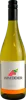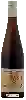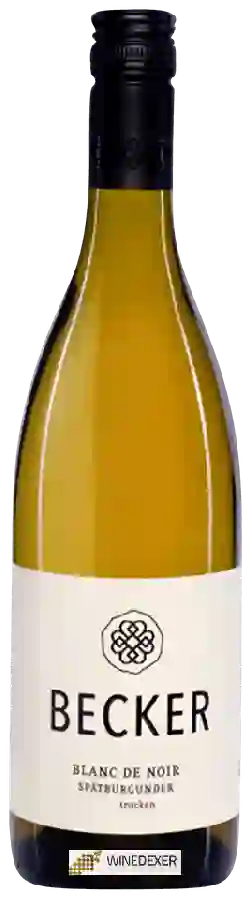
Winery Karlheinz BeckerBlanc de Noir Spätburgunder Trocken
 White wine


This wine generally goes well with vegetarian
Food and wine pairings with Blanc de Noir Spätburgunder Trocken
Pairings that work perfectly with Blanc de Noir Spätburgunder Trocken

Original food and wine pairings with Blanc de Noir Spätburgunder Trocken
The Blanc de Noir Spätburgunder Trocken of Winery Karlheinz Becker matches generally quite well with dishes of vegetarian such as recipes of quiche with bacon and gruyère cheese.
Details and technical informations about Winery Karlheinz Becker's Blanc de Noir Spätburgunder Trocken.
Discover the grape variety: Sauvignon-Rytos
An interspecific cross between Sauvignon Blanc and Bianca obtained in Italy and in 2002 by the University of Udine and the Institute of Applied Genetics. It should not be confused with the sauvignon-kretos. It can be found in Germany, Poland, ... in France it is almost unknown.
Last vintages of this wine
The best vintages of Blanc de Noir Spätburgunder Trocken from Winery Karlheinz Becker are 2015, 0
Informations about the Winery Karlheinz Becker
The Winery Karlheinz Becker is one of of the world's greatest estates. It offers 31 wines for sale in the of Pfalz to come and discover on site or to buy online.

The wine region of Pfalz
Pfalz is a key wine producing region in western Germany, located between the Rhein/Rhine river and the low-lying Haardt mountain range (a natural continuation of the Alsatian Vosges). It covers a rectangle of land 45 miles (75km) Long and 15 miles (25km) wide. To the NorthLiesRheinhessen; to the South, the French border and Alsace. In terms of both quality and quantity, Pfalz is one of Germany's most important regions, and one which shows great promise for the future.
The word of the wine: Solera
A method of maturing practiced in Andalusia for certain sherries, which aims to continuously blend older and younger wines. It consists of stacking several layers of barrels; those located at ground level (solera) contain the oldest wines, the youngest being stored in the barrels on the upper level. The wine to be bottled is taken from the barrels on the lower level, which is replaced by younger wine from the upper level, and so on.