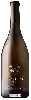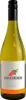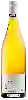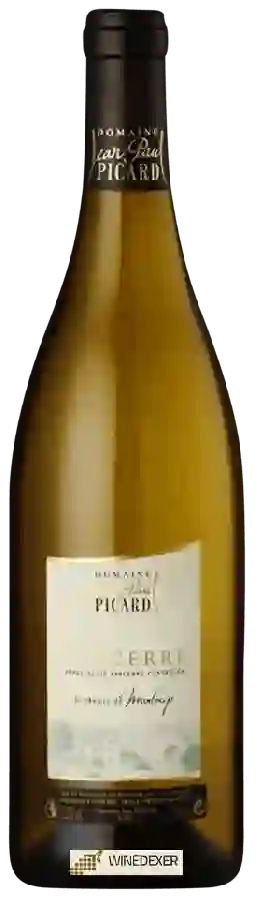
Winery Jean-Paul PicardSancerre Blanc
 White wine



In the mouth this white wine is a with a nice freshness.
This wine generally goes well with pork, vegetarian or shellfish.
Taste structure of the Sancerre Blanc from the Winery Jean-Paul Picard
Light | Bold | |
Dry | Sweet | |
Soft | Acidic |
In the mouth the Sancerre Blanc of Winery Jean-Paul Picard in the region of Loire Valley is a with a nice freshness.
Wine flavors and olphactive analysis


On the nose the Sancerre Blanc of Winery Jean-Paul Picard in the region of Loire Valley often reveals types of flavors of citrus, apples or pear and sometimes also flavors of tree fruit, citrus fruit.
Food and wine pairings with Sancerre Blanc
Pairings that work perfectly with Sancerre Blanc



Original food and wine pairings with Sancerre Blanc

The Sancerre Blanc of Winery Jean-Paul Picard matches generally quite well with dishes of pork, shellfish or spicy food such as recipes of broccoli gratin, mussels with white wine and tomato or pho soup.
Details and technical informations about Winery Jean-Paul Picard's Sancerre Blanc.
Discover the grape variety: Cornalin du Valais
Very old vine cultivated in the Swiss Valais, resulting from a natural crossing between the petit rouge(*) and the mayolet. It is the father of red humagne, also called cornalin d'Aoste, the grandfather of durize or petit rouge du Valais or rouge de Fully and a relative of goron. - Synonymy: old red of Valais, red of the country in Switzerland, landroter (for all the synonyms of the grape varieties, click here!). - Description: medium-sized bunches, cylindrical, winged, compact, strong medium-sized peduncles with little lignification; medium-sized berries, spherical or short elliptical, skin of a beautiful bluish black colour with a lot of bloom. The foliage turns completely red in the fall. - Production potential: early budding in the year. Capricious and difficult variety. Particularly likes the limestone soils of well exposed hillsides that warm up quickly enough, lean and well drained. Semi-erect bearing, vigorous with irregular production. Resists well to winter frosts. Susceptible to the main diseases, especially to oidium and grey rot. Also susceptible to magnesium deficiency and stalk dehydration. Maturity: 3rd early season
Last vintages of this wine
The best vintages of Sancerre Blanc from Winery Jean-Paul Picard are 2015
Informations about the Winery Jean-Paul Picard
The Winery Jean-Paul Picard is one of of the world's greatest estates. It offers 12 wines for sale in the of Sancerre to come and discover on site or to buy online.

The wine region of Sancerre
The wine region of Sancerre is located in the region of Haute Loire of Loire Valley of France. Wineries and vineyards like the Domaine Edmond Vatan or the Domaine Jean-Paul Balland produce mainly wines white, red and pink. The most planted grape varieties in the region of Sancerre are Pinot noir, Chenin blanc and Chardonnay, they are then used in wines in blends or as a single variety. On the nose of Sancerre often reveals types of flavors of pineapple, wood smoke or jasmine and sometimes also flavors of fennel, pink grapefruit or green bell pepper.
The wine region of Loire Valley
The Loire Valley is a key wine region in western France. It follows the course of the Loire River on its Long journey through the heart of France, from the inland hills of the Auvergne to the plains of the French Atlantic coast near Nantes (Muscadet country). Important in terms of quantity and quality, the region produces large quantities (about 4 million h/l each year) of everyday wines, as well as some of France's greatest wines. Diversity is another of the region's major assets; the styles of wine produced here range from the light, tangy Muscadet to the Sweet, honeyed Bonnezeaux, the Sparkling whites of Vouvray and the juicy, Tannic reds of Chinon and Saumur.
The word of the wine: Viscosity
Consistency of wine reminiscent of the tactile sensation of sugar syrup with varying degrees of fluidity, due to the alcohol and natural sugar in the grapes present in sweet wines. In excess, this sensation can make the wine pasty and heavy. To the eye, viscosity is referred to as tears.