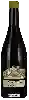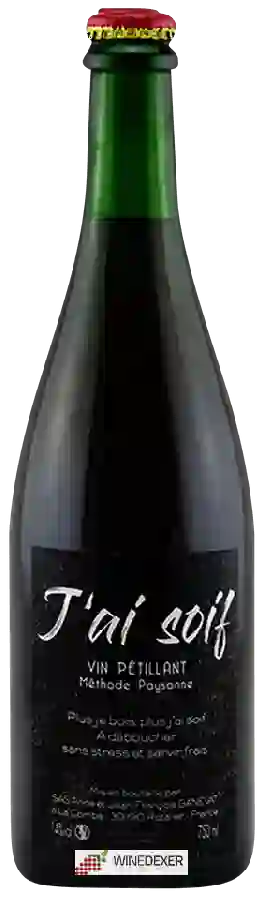
Winery Jean François GanevatJ'ai Soif Pétillant
 Sparkling wine


This wine generally goes well with beef and mature and hard cheese.
Wine flavors and olphactive analysis


On the nose the J'ai Soif Pétillant of Winery Jean François Ganevat in the region of Pays d'Oc often reveals types of flavors of cherry, strawberries or pomegranate and sometimes also flavors of microbio, red fruit.
Food and wine pairings with J'ai Soif Pétillant
Pairings that work perfectly with J'ai Soif Pétillant


Original food and wine pairings with J'ai Soif Pétillant
The J'ai Soif Pétillant of Winery Jean François Ganevat matches generally quite well with dishes of beef or mature and hard cheese such as recipes of picadillo or pancake cake with mountain filling.
Details and technical informations about Winery Jean François Ganevat's J'ai Soif Pétillant.
Discover the grape variety: Villard blanc
Interspecific crossing between 6468 Seibel and 6905 Seibel or subéreux, obtained by the House of Seyve-Villard of Saint Vallier in the Drôme. Together with Villard noir or 18315 Seyve-Villard, these were the two most widely propagated direct-producing hybrids. The white Villard has also been used as a progenitor for new varieties. It can be found in Hungary, Mexico, Brazil, Canada, the United States and Japan. In the south of France, some old vines still exist. We have also found it in private homes where it is grown in pergolas for the consumption of its excellent grapes at full maturity. Today, it is on the verge of extinction, although it is registered in the Official Catalogue of wine grape varieties, list A1.
Last vintages of this wine
The best vintages of J'ai Soif Pétillant from Winery Jean François Ganevat are 2017
Informations about the Winery Jean François Ganevat
The Winery Jean François Ganevat is one of of the world's great estates. It offers 103 wines for sale in the of Vin de Pays to come and discover on site or to buy online.

The wine region of Vin de Pays
Vin de Pays (VDP), the French national equivalent of PGI (Protected Geographical Indication) at the European level, is a quality category of French wines, positioned between Vin de Table (VDT) and Appellation d'Origine Contrôlée (AOC). This layer of the French appellation system was initially introduced in September 1968 by the INAO, the official appellation authority. It underwent several early revisions in the 1970s, followed by substantial changes in September 2000 and again in 2009, when all existing VDT titles were automatically registered with the European Union as PGI. Producers retain the choice of using either the VDP or PGI titles on their labels, or both - in the form "IGP-Vin de Pays".
The wine region of Pays d'Oc
Pays d'Oc is the PGI for red, white and rosé wines that are produced over a wide area of the southern coast of France. The PGI catchment area corresponds roughly to the Languedoc-roussillon">Languedoc-Roussillon wine region, one of the largest wine regions in France. The area covers all wines that are not produced under the strict laws that govern AOC-level appellations in the regions: among them, Corbières, Minervois and the Languedoc appellation itself. The Pays d'Oc PGI is arguably the most important in France, producing the majority of the country's PGI wines.
The word of the wine: Right bank
In Bordeaux, it refers to the vineyards located on the right bank of the Gironde and Dordogne rivers, where the Merlot grape variety is dominant. These are the appellations of Saint-Emilion, Pomerol, Fronsac, etc.