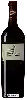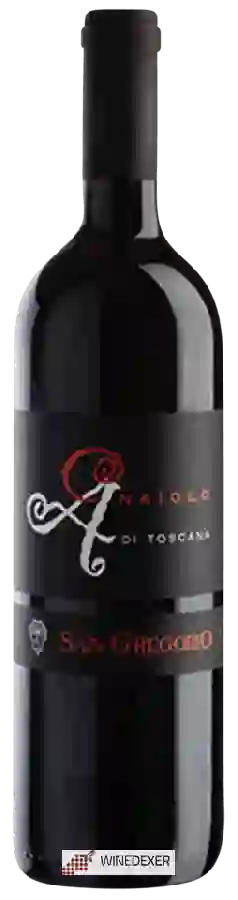
Winery San GregorioCanaiolo di Toscana
 Red wine



In the mouth this red wine is a powerful with a nice balance between acidity and tannins.
This wine generally goes well with poultry, beef or veal.
Taste structure of the Canaiolo di Toscana from the Winery San Gregorio
Light | Bold | |
Smooth | Tannic | |
Dry | Sweet | |
Soft | Acidic |
In the mouth the Canaiolo di Toscana of Winery San Gregorio in the region of Tuscany is a powerful with a nice balance between acidity and tannins.
Wine flavors and olphactive analysis

On the nose the Canaiolo di Toscana of Winery San Gregorio in the region of Tuscany often reveals types of flavors of red fruit.
Food and wine pairings with Canaiolo di Toscana
Pairings that work perfectly with Canaiolo di Toscana



Original food and wine pairings with Canaiolo di Toscana


The Canaiolo di Toscana of Winery San Gregorio matches generally quite well with dishes of beef, lamb or veal such as recipes of chickpeas spanish style, shish kebab or duck with orange.
Details and technical informations about Winery San Gregorio's Canaiolo di Toscana.
Discover the grape variety: Amandin
Interspecific cross between 7489 (direct white producer hybrid) and Hamburg Muscat obtained in 1979, registered in the Official Catalogue of table grape varieties list A1.
Last vintages of this wine
The best vintages of Canaiolo di Toscana from Winery San Gregorio are 2015, 0
Informations about the Winery San Gregorio
The Winery San Gregorio is one of of the world's greatest estates. It offers 7 wines for sale in the of Tuscany to come and discover on site or to buy online.

The wine region of Tuscany
Tuscany is one of the most famous and prolific wine regions in Europe. It is best known for its Dry red wines made from Sangiovese grapes, which dominate production. These include Chianti, Brunello di Montalcino and Vino Nobile di Montepulciano. The region's Vin Santo is also highly prized, as are its passito dessert wines, though these are produced in comparatively tiny quantities.
The word of the wine: Ugni blanc
White grape variety of Italian origin, and the main white variety grown in France. Its large bunches give fine, light and lively wines, suitable for distillation: today it is the main variety for making cognac and armagnac. Ugni blanc, which is a little richer in alcohol when grown in Mediterranean regions, is used in the blending of the Provence and Corsica appellations, often in association with other grape varieties that bring aromas and structure, such as clairette, grenache blanc or sauvignon. Ugni blanc is also used, on a secondary basis, in the production of certain white wines in Gironde (AOC Bordeaux, Entre-deux-Mers, etc.).