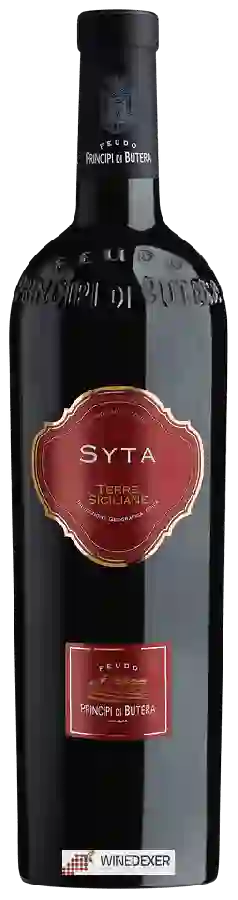
Winery Principi di ButeraSyta
 Red wine



In the mouth this red wine is a powerful.
This wine generally goes well with beef, lamb or pasta.

Taste structure of the Syta from the Winery Principi di Butera
Light | Bold | |
Smooth | Tannic | |
Dry | Sweet | |
Soft | Acidic |
In the mouth the Syta of Winery Principi di Butera in the region of Sicily is a powerful.
Food and wine pairings with Syta
Pairings that work perfectly with Syta



Original food and wine pairings with Syta
The Syta of Winery Principi di Butera matches generally quite well with dishes of beef, pasta or lamb such as recipes of chicken, beef and lamb couscous (morocco), vegetarian lasagna or leg of lamb in braillouse.
Details and technical informations about Winery Principi di Butera's Syta.
Discover the grape variety: Petit Verdot
Dark, full-bodied reds with tight tannins and inky colour, showing aromas of blackberry, violet, gentle spice, liquorice and mentholated balsamic notes. Contributes colour, structure and aromatic freshness to great Médoc blends (Palmer, Léoville-Las Cases) where it remains a minority. Also vinified as a single variety in Spain (La Mancha), California, Australia and Argentina. A late-ripening Bordeaux variety.
Last vintages of this wine
The best vintages of Syta from Winery Principi di Butera are 2015, 2013, 2014, 0 and 2012.
Informations about the Winery Principi di Butera
The Winery Principi di Butera is one of of the world's great estates. It offers 26 wines for sale in the of Sicily to come and discover on site or to buy online.

The wine region of Sicily
Major qualitative renewal. Sunny, expressive reds: fleshy, spicy Nero d'Avola (black cherry, blackberry, liquorice), fine, mineral Nerello Mascalese on Etna (recalls Pinot Noir), light, crisp Frappato in Cerasuolo di Vittoria DOCG. Lively, saline whites: Catarratto, fat, iodised Grillo, taut Carricante, floral Inzolia. Amber, walnutty fortified Marsala.
The word of the wine: Consistency
In tasting, it is the equivalent of chewing (the chewiness of a tannic red wine is also mentioned). We then speak of firmness, fluidity, softness, hardness, and why not the crunchiness of an early wine by reference to the grape.