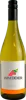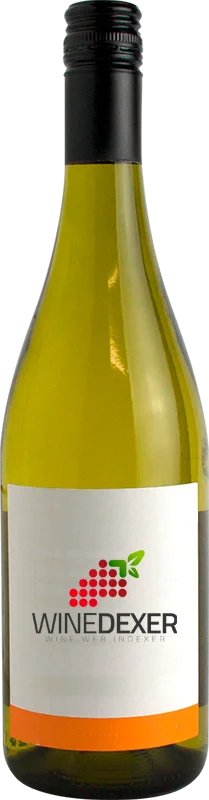
Winery HochWeisser Stein Sauvignon Blanc
 White wine
In the mouth this white wine is a with a nice freshness.
This wine generally goes well with vegetarian, shellfish or goat cheese.
Taste structure of the Weisser Stein Sauvignon Blanc from the Winery Hoch
Light | Bold | |
Dry | Sweet | |
Soft | Acidic |
In the mouth the Weisser Stein Sauvignon Blanc of Winery Hoch in the region of Weinland is a with a nice freshness.
Food and wine pairings with Weisser Stein Sauvignon Blanc
Pairings that work perfectly with Weisser Stein Sauvignon Blanc



Original food and wine pairings with Weisser Stein Sauvignon Blanc
The Weisser Stein Sauvignon Blanc of Winery Hoch matches generally quite well with dishes of shellfish, vegetarian or goat cheese such as recipes of paella from an old spanish grandmother..., zucchini quiche or pan-fried courgette, tomatoes and goat's cheese.
Details and technical informations about Winery Hoch's Weisser Stein Sauvignon Blanc.
Discover the grape variety: Muscaris
An interspecific cross between Solaris and Muscat à petits grains blancs, obtained in Freiburg (Germany) in 1987 by Norbert Becker. It has the particularity of having only one gene for resistance to mildew and powdery mildew. Muscaris can be found in Germany, the Netherlands, Italy and France.
Informations about the Winery Hoch
The Winery Hoch is one of of the world's greatest estates. It offers 5 wines for sale in the of Kremstal to come and discover on site or to buy online.

The wine region of Kremstal
The wine region of Kremstal is located in the region of Niederösterreich of Weinland of Austria. We currently count 108 estates and châteaux in the of Kremstal, producing 798 different wines in conventional, organic and biodynamic agriculture. The wines of Kremstal go well with generally quite well with dishes .
The wine region of Weinland
Weinviertel DAC – whose name translates as "wine quarter" – is an appellation in Niederösterreich (Lower Austria). It is by far the largest Districtus Austriae Controllatus wine region in Austria. It was also the first Austrian wine region to be given that title, in 2002, with a DAC Reserve designation added in 2009. The designation applies only to white wines from the Grüner Veltliner Grape variety.
The word of the wine: Vinification of sweet wines
Moelleux and liquoreux wines are characterized by the presence of residual sugars (natural sugar of the grape), not transformed into alcohol under the effect of yeasts. The fermentation is stopped by cold and by the addition of sulphur dioxide (sulphur).