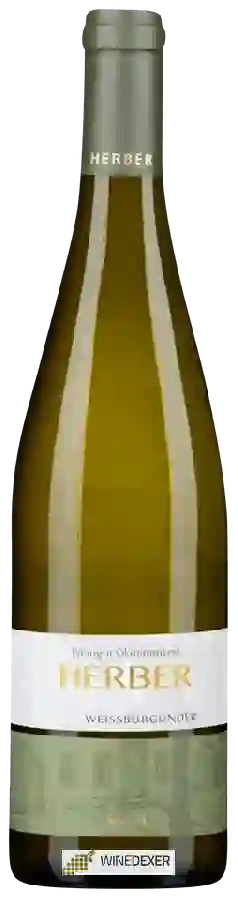
Winery HerberWeissburgunder
 White wine


In the mouth this white wine is a with a nice freshness.
This wine generally goes well with rich fish (salmon, tuna etc), shellfish or mild and soft cheese.
Taste structure of the Weissburgunder from the Winery Herber
Light | Bold | |
Dry | Sweet | |
Soft | Acidic |
In the mouth the Weissburgunder of Winery Herber in the region of Mosel is a with a nice freshness.
Food and wine pairings with Weissburgunder
Pairings that work perfectly with Weissburgunder


Original food and wine pairings with Weissburgunder

The Weissburgunder of Winery Herber matches generally quite well with dishes of rich fish (salmon, tuna etc), shellfish or mild and soft cheese such as recipes of sea sauerkraut with white wine, baeckeoffe with fish or croziflette.
Details and technical informations about Winery Herber's Weissburgunder.
Discover the grape variety: Ravat noir
Obtained by Jean-François Ravat, it is an interspecific cross between 8365 Seibel and pinot noir. In France, this direct-producing hybrid has been little multiplied.
Last vintages of this wine
The best vintages of Weissburgunder from Winery Herber are 0
Informations about the Winery Herber
The Winery Herber is one of of the world's greatest estates. It offers 21 wines for sale in the of Mosel to come and discover on site or to buy online.

The wine region of Mosel
Mosel is the most famous of Germany's 13 official wine regions, and also the third largest in terms of production. As with many German regions, it is most aasociated with a range of wine styles made from the Riesling grape variety, but Müller-Thurgau is also widely planted. The best Mosel Riesling wines are some of the finest whites in the world. Light and low in Alcohol, they can be intensely fragrant with beguiling Floral">floral and Mineral notes, and a wonderful Balance of sweetness and Acidity.
The word of the wine: Oenologist
Specialist in wine-making techniques. It is a profession and not a passion: one can be an oenophile without being an oenologist (and the opposite too!). Formerly attached to the Faculty of Pharmacy, oenology studies have become independent and have their own university course. Learning to make wine requires a good chemical background but also, increasingly, a good knowledge of the plant. Some oenologists work in laboratories (analysis). Others, the consulting oenologists, work directly in the properties.