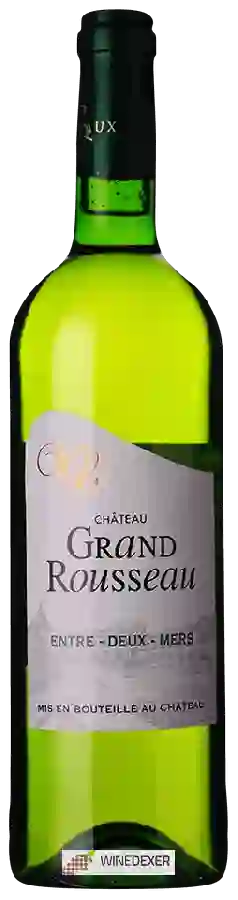
Château Grand RousseauEntre-deux-Mers
 White wine


In the mouth this white wine is a powerful.
This wine generally goes well with pork, vegetarian or poultry.

Taste structure of the Entre-deux-Mers from the Château Grand Rousseau
Light | Bold | |
Dry | Sweet | |
Soft | Acidic |
In the mouth the Entre-deux-Mers of Château Grand Rousseau in the region of Bordeaux is a powerful.
Wine flavors and olphactive analysis

On the nose the Entre-deux-Mers of Château Grand Rousseau in the region of Bordeaux often reveals types of flavors of pineapple, citrus or citrus fruit and sometimes also flavors of tropical fruit.
Food and wine pairings with Entre-deux-Mers
Pairings that work perfectly with Entre-deux-Mers



Original food and wine pairings with Entre-deux-Mers


The Entre-deux-Mers of Château Grand Rousseau matches generally quite well with dishes of pork, vegetarian or poultry such as recipes of sloth pork loin, vegan leek and tofu quiche or teriyaki chicken.
Details and technical informations about Château Grand Rousseau's Entre-deux-Mers.
Discover the grape variety: Rossignola
Light and fruity reds with a pale ruby robe, melted tannins and an airy palate with preserved acidity, showing signature aromas of red fruits (cherry, morello cherry), gentle spices and Venetian floral notes. Airy profile adding freshness to blends. Traditional component of Valpolicella DOC and Bardolino DOC, contributing to the identity of Venetian reds from Lake Garda. Native black Italian grape from Veneto, grown mainly in Valpolicella.
Last vintages of this wine
The best vintages of Entre-deux-Mers from Château Grand Rousseau are 2016, 2015, 2013, 2014
Informations about the Château Grand Rousseau
The Château Grand Rousseau is one of of the world's greatest estates. It offers 6 wines for sale in the of Entre-deux-Mers to come and discover on site or to buy online.

The wine region of Entre-deux-Mers
Fresh, aromatic dry whites between the Dordogne and Garonne, the accessible face of Bordeaux. Sauvignon Blanc leads with signature notes of grapefruit, boxwood, white flowers and a mineral touch, taut and thirst-quenching palate. Sémillon adds roundness and white peach, Muscadelle musky-floral, Sauvignon Gris ampleness. Complementary Merlot reds (cherry, ripe plum, supple tannins).
The wine region of Bordeaux
World-renowned age-worthy reds, led by round Merlot (plum, black fruit) or firm Cabernet Sauvignon (blackcurrant, cedar, graphite), blended with Cabernet Franc and Petit Verdot for tannic structure. Structured Médoc and Graves, velvety Saint-Émilion and Pomerol. Also crisp dry whites (Sauvignon/Sémillon) and opulent sweet Sauternes with honey and candied fruit. A 110,000 ha Gironde vineyard, 65 appellations, cradle of the 1855 classified growths.
The word of the wine: Oenologist
Specialist in wine-making techniques. It is a profession and not a passion: one can be an oenophile without being an oenologist (and the opposite too!). Formerly attached to the Faculty of Pharmacy, oenology studies have become independent and have their own university course. Learning to make wine requires a good chemical background but also, increasingly, a good knowledge of the plant. Some oenologists work in laboratories (analysis). Others, the consulting oenologists, work directly in the properties.