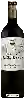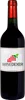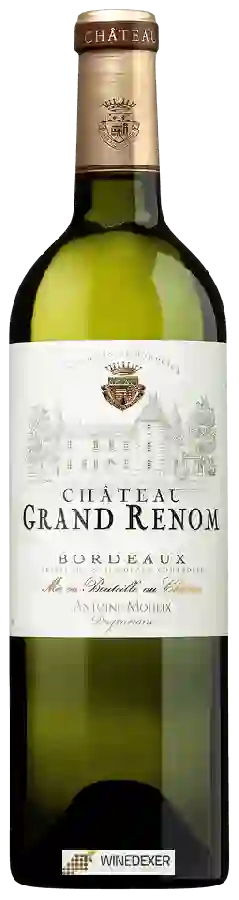
Château Grand RenomBordeaux Blanc
 White wine



In the mouth this white wine is a powerful with a nice freshness.
This wine generally goes well with pork, vegetarian or poultry.

Taste structure of the Bordeaux Blanc from the Château Grand Renom
Light | Bold | |
Dry | Sweet | |
Soft | Acidic |
In the mouth the Bordeaux Blanc of Château Grand Renom in the region of Bordeaux is a powerful with a nice freshness.
Wine flavors and olphactive analysis






On the nose the Bordeaux Blanc of Château Grand Renom in the region of Bordeaux often reveals types of flavors of pineapple, grapefruit or oaky and sometimes also flavors of citrus, apples or butter.
Food and wine pairings with Bordeaux Blanc
Pairings that work perfectly with Bordeaux Blanc



Original food and wine pairings with Bordeaux Blanc


The Bordeaux Blanc of Château Grand Renom matches generally quite well with dishes of pork, vegetarian or poultry such as recipes of rabbit stew the old fashioned way, magic cake cheese quiche or pad thai.
Details and technical informations about Château Grand Renom's Bordeaux Blanc.
Discover the grape variety: Tinto cão
Structured, elegant reds with a deep ruby robe, fine tannins and fresh acidity, featuring aromas of red fruits, black cherry, spices, dried flowers and balsamic notes. Very good ageing and oxidative maturation capacity. An essential component of great vintage Porto (one of the five classic recommended grapes) and dry reds of Douro DOC. Very late-ripening, low-yield native Portuguese grape, saved from near-disappearance.
Last vintages of this wine
The best vintages of Bordeaux Blanc from Château Grand Renom are 2017, 2018, 2016, 2015 and 2014.
Informations about the Château Grand Renom
The Château Grand Renom is one of of the world's greatest estates. It offers 9 wines for sale in the of Bordeaux to come and discover on site or to buy online.

The wine region of Bordeaux
World-renowned age-worthy reds, led by round Merlot (plum, black fruit) or firm Cabernet Sauvignon (blackcurrant, cedar, graphite), blended with Cabernet Franc and Petit Verdot for tannic structure. Structured Médoc and Graves, velvety Saint-Émilion and Pomerol. Also crisp dry whites (Sauvignon/Sémillon) and opulent sweet Sauternes with honey and candied fruit. A 110,000 ha Gironde vineyard, 65 appellations, cradle of the 1855 classified growths.
The word of the wine: Residual sugars
Sugars not transformed into alcohol and naturally present in the wine. The perception of residual sugars is conditioned by the acidity of the wine. The more acidic the wine is, the less sweet it will seem, given the same amount of sugar.