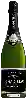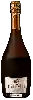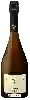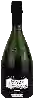
Winery G.H. MartelCoeur de Cuvée Spéciale Brut Champagne Premier Cru
 Sparkling wine



In the mouth this sparkling wine is a powerful with a nice vivacity and a fine and pleasant bubble.
This wine generally goes well with pork, rich fish (salmon, tuna etc) or shellfish.

Taste structure of the Coeur de Cuvée Spéciale Brut Champagne Premier Cru from the Winery G.H. Martel
Light | Bold | |
Soft | Acidic | |
Gentle | Fizzy |
In the mouth the Coeur de Cuvée Spéciale Brut Champagne Premier Cru of Winery G.H. Martel in the region of Champagne is a powerful with a nice vivacity and a fine and pleasant bubble.
Wine flavors and olphactive analysis




On the nose the Coeur de Cuvée Spéciale Brut Champagne Premier Cru of Winery G.H. Martel in the region of Champagne often reveals types of flavors of cream, citrus or apples and sometimes also flavors of butter, green apple or minerality.
Food and wine pairings with Coeur de Cuvée Spéciale Brut Champagne Premier Cru
Pairings that work perfectly with Coeur de Cuvée Spéciale Brut Champagne Premier Cru



Original food and wine pairings with Coeur de Cuvée Spéciale Brut Champagne Premier Cru

The Coeur de Cuvée Spéciale Brut Champagne Premier Cru of Winery G.H. Martel matches generally quite well with dishes of pork, rich fish (salmon, tuna etc) or shellfish such as recipes of pumpkin and bacon pie, sea bream a la plancha or pasta shells.
Details and technical informations about Winery G.H. Martel's Coeur de Cuvée Spéciale Brut Champagne Premier Cru.
Discover the grape variety: Merlot
Round and fleshy reds with a velvety texture, showing aromas of ripe plum, black cherry, cocoa and truffle notes with age. Supple tannins, generous alcohol, indulgent finish. Pillar of Libournais (Pomerol with Pétrus, Saint-Émilion with Cheval Blanc and Ausone) and signature of Super Tuscans, Italian Wales and Washington State. A cross of Cabernet Franc × Magdeleine Noire, France's most planted red variety.
Last vintages of this wine
The best vintages of Coeur de Cuvée Spéciale Brut Champagne Premier Cru from Winery G.H. Martel are 2005, 2009, 2008
Informations about the Winery G.H. Martel
The Winery G.H. Martel is one of of the world's greatest estates. It offers 36 wines for sale in the of Champagne Premier Cru to come and discover on site or to buy online.

The wine region of Champagne Premier Cru
High-end Champagnes from 44 villages rated 90-99% on the cru scale (1919), between Grand Cru and generic. Fine, elegant sparklers based on Chardonnay (citrus, brioche, chalk), Pinot Noir (red fruits, structure) and Pinot Meunier (fruity roundness). Fine bubbles, controlled dosage, complexity heightened by lees ageing. Villages in the Montagne de Reims, Côte des Blancs and around Épernay.
The wine region of Champagne
World benchmark sparkling wines: fine bubbles, citrusy tension, notes of brioche, toasted almond, white flowers and white-fleshed fruits after ageing on lees. Three grapes blended or solo: fleshy Pinot Noir (38%), fruity Meunier (33%), chiselled Chardonnay (28%). From straight Blanc de Blancs to vinous Blanc de Noirs, from non-vintage Brut to age-worthy Millésimé. AOC since 1927, 34,300 ha on chalk, 17 Grands Crus and 44 Premiers Crus.
The word of the wine: Leaflet
Small barrel with a capacity of 112 to 136 litres depending on the region.