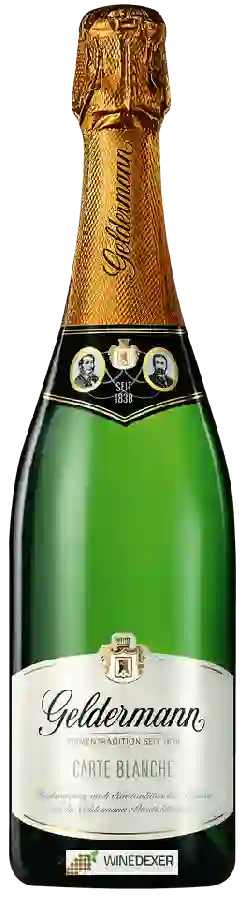
Winery GeldermannCarte Blanche
 Sparkling wine



This wine is a blend of 2 varietals which are the Chardonnay and the Pinot noir.
This wine generally goes well with pork, vegetarian or poultry.

Wine flavors and olphactive analysis





On the nose the Carte Blanche of Winery Geldermann in the region of Baden often reveals types of flavors of apples, apricot or honey and sometimes also flavors of non oak, earth or microbio.
Food and wine pairings with Carte Blanche
Pairings that work perfectly with Carte Blanche



Original food and wine pairings with Carte Blanche



The Carte Blanche of Winery Geldermann matches generally quite well with dishes of veal, pork or game (deer, venison) such as recipes of chicken and sausage stew with carrots, country-style snow peas or rabbit with marengo sauce.
Details and technical informations about Winery Geldermann's Carte Blanche.
Discover the grape variety: Chardonnay
Whites with many faces: mineral and taut at Chablis (lemon, green apple, flint), opulent and buttery at Meursault and Puligny-Montrachet (hazelnut, brioche, yellow fruits), tense and chalky in Champagne (Blanc de Blancs). Also vinified sparkling and widely exported (Sonoma, Margaret River, Casablanca). A Burgundian variety, a cross of Pinot Noir × Gouais Blanc, half-sibling of Aligoté.
Last vintages of this wine
The best vintages of Carte Blanche from Winery Geldermann are 2013, 2008, 2014
Informations about the Winery Geldermann
The Winery Geldermann is one of of the world's greatest estates. It offers 27 wines for sale in the of Baden to come and discover on site or to buy online.

The wine region of Baden
German capital of Pinot Noir (Spätburgunder): silky, fine reds with notes of red fruits, cherry, undergrowth and sweet spices, melted tannins. Round Grauburgunder (Pinot Gris), lively Weissburgunder, supple Müller-Thurgau, mineral Riesling. Germany's 3rd region (15,000 ha) in Baden-Württemberg facing Alsace, one of the country's warmest climates, volcanic soils at the Kaiserstuhl. Cradle of modern great German reds, elegant and fine.
The word of the wine: Old vines
There are no specific regulations governing the term "vieilles vignes". After 20 to 25 years, the yields stabilize and tend to decrease, the vines are deeply rooted, and the grapes that come from them give richer, more concentrated, more sappy wines, expressing with more nuance the characteristics of their terroir. It is possible to find plots of vines that claim to be a century old.


