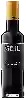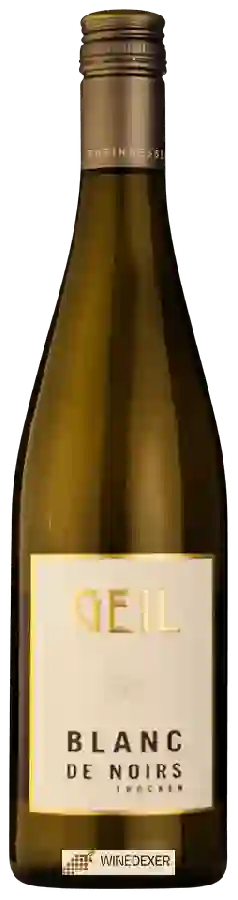
Weingut GeilBlanc de Noirs Trocken
 White wine



This wine generally goes well with vegetarian
Wine flavors and olphactive analysis


On the nose the Blanc de Noirs Trocken of Weingut Geil in the region of Rheinhessen often reveals types of flavors of non oak, earth or oak and sometimes also flavors of tree fruit, citrus fruit.
Food and wine pairings with Blanc de Noirs Trocken
Pairings that work perfectly with Blanc de Noirs Trocken

Original food and wine pairings with Blanc de Noirs Trocken
The Blanc de Noirs Trocken of Weingut Geil matches generally quite well with dishes of vegetarian such as recipes of spinach and goat cheese quiche.
Details and technical informations about Weingut Geil's Blanc de Noirs Trocken.
Discover the grape variety: Aubun
Aubun is not to be confused with another grape variety with the same sound, aubin. This one is a black grape plant of which the Vaucluse is the probable cradle. Covering nearly 5,400 hectares of vineyards in the late 1990s, its cultivation was reduced to some 1,400 hectares in the mid-2000s. California and Australia also have discreet plantations. In the Var, Lot-et-Garonne, Gers, Ardèche and other departments, aubun is authorized, if not recommended. Its third-period ripeness promises medium to large bunches of compact, cylindrical grapes that will produce medium-quality wine. Quite alcoholic, the wine produced from Aubun is a lightly colored red. After budburst, the shoots bear young branches covered with a cottony veil. The young leaves are yellowish and downy. The older ones have pubescent, cottony blades with 5 to 7 limbs.
Last vintages of this wine
The best vintages of Blanc de Noirs Trocken from Weingut Geil are 2016, 2014, 2015, 0 and 2019.
Informations about the Weingut Geil
The Weingut Geil is one of of the world's great estates. It offers 94 wines for sale in the of Rheinhessen to come and discover on site or to buy online.

The wine region of Rheinhessen
Rheinhessen is Germany's largest region for producing the quality wines of the Qualitätswein bestimmter Anbaugebiete (QbA) and Prädikatswein designations, with roughly 26,500 hectares (65,000 acres) of Vineyard">Vineyards as of 2014. Many of its most significant viticultural areas are favorably influenced by the Rhine river, which runs aLong its North and eastern borders. The Rhine, along with the Nahe river to the west and the Haardt mountains to its South, form a natural border. Rheinhessen covers an area south of Rheingau, north of Pfalz and east of Nahe, and is located within the Rhineland-Palatinate federal state.
The word of the wine: Second fermentation
In the making of champagne, fermentation of the base wine to which is added the liqueur de tirage and which takes place in the bottle. This second fermentation produces the carbon dioxide, and therefore the bubbles that make up the effervescence of the wine.