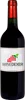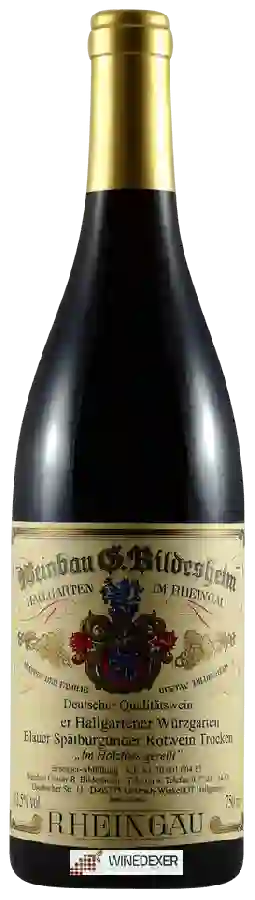
Winery Weinbau G. BildesheimHallgartener Würzgarten Blauer Spätburgunder Trocken
 Red wine


In the mouth this red wine is a with a nice freshness.
This wine generally goes well with poultry, beef or veal.
Taste structure of the Hallgartener Würzgarten Blauer Spätburgunder Trocken from the Winery Weinbau G. Bildesheim
Light | Bold | |
Smooth | Tannic | |
Dry | Sweet | |
Soft | Acidic |
In the mouth the Hallgartener Würzgarten Blauer Spätburgunder Trocken of Winery Weinbau G. Bildesheim in the region of Rheingau is a with a nice freshness.
Wine flavors and olphactive analysis


On the nose the Hallgartener Würzgarten Blauer Spätburgunder Trocken of Winery Weinbau G. Bildesheim in the region of Rheingau often reveals types of flavors of non oak, oak or spices and sometimes also flavors of red fruit, black fruit.
Food and wine pairings with Hallgartener Würzgarten Blauer Spätburgunder Trocken
Pairings that work perfectly with Hallgartener Würzgarten Blauer Spätburgunder Trocken



Original food and wine pairings with Hallgartener Würzgarten Blauer Spätburgunder Trocken

The Hallgartener Würzgarten Blauer Spätburgunder Trocken of Winery Weinbau G. Bildesheim matches generally quite well with dishes of beef, veal or game (deer, venison) such as recipes of pasta bolognese, blanquette of veal or civet of wild boar.
Details and technical informations about Winery Weinbau G. Bildesheim's Hallgartener Würzgarten Blauer Spätburgunder Trocken.
Discover the grape variety: Cornichon blanc
A very old variety that has been multiplied in many Mediterranean wine-producing countries, due to the fact that its grapes ripen quite late. It is only in Italy and Greece that it still occupies a significant area. In France, it is only found among amateur gardeners and/or collectors. By its foliage in particular, the white gherkin is different from the purple gherkin this last one is given as very little sensitive to the grey rot.
Last vintages of this wine

The best vintages of Hallgartener Würzgarten Blauer Spätburgunder Trocken from Winery Weinbau G. Bildesheim are 2009, 0, 2010
Informations about the Winery Weinbau G. Bildesheim
The Winery Weinbau G. Bildesheim is one of of the world's greatest estates. It offers 10 wines for sale in the of Rheingau to come and discover on site or to buy online.

The wine region of Rheingau
Rheingau is one of the most important of Germany's 13 Anbaugebiete wine regions. However it is far from the biggest; with 3,076 hectares (7,600 acres) of Vineyard">Vineyards documented in 2012, its output is around one tenth of that from the Pfalz and Rheinhessen regions. Located on the Rhine a 20-minute drive west of Frankfurt, the -gau suffix denotes that it was once a county of the Frankish Empire. The classic Rheingau wine is a DryRiesling with pronounced Acidity and aromas of citrus fruits and smoke-tinged minerality – typically more "masculine" than its equivalent from the Mosel.
The word of the wine: Wiring
Action of periodically filling barrels containing wine, in order to offset evaporation and maintain a maximum level. The topping up allows to avoid the phenomenon of oxidation.