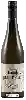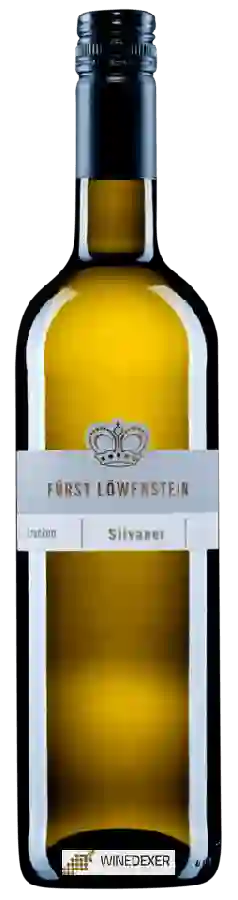
Winery Fürst LöwensteinSilvaner Trocken
 White wine



In the mouth this white wine is a with a nice freshness.
This wine generally goes well with pork, vegetarian or poultry.
Taste structure of the Silvaner Trocken from the Winery Fürst Löwenstein
Light | Bold | |
Dry | Sweet | |
Soft | Acidic |
In the mouth the Silvaner Trocken of Winery Fürst Löwenstein in the region of Franken is a with a nice freshness.
Food and wine pairings with Silvaner Trocken
Pairings that work perfectly with Silvaner Trocken



Original food and wine pairings with Silvaner Trocken


The Silvaner Trocken of Winery Fürst Löwenstein matches generally quite well with dishes of veal, pork or vegetarian such as recipes of veal saltimbocca, savoyard crozet gratin or magic cake cheese quiche.
Details and technical informations about Winery Fürst Löwenstein's Silvaner Trocken.
Discover the grape variety: Gros Manseng
Gros Manseng blanc is a grape variety that originated in France (Netherlands). It produces a variety of grape specially used for wine making. It is rare to find this grape to eat on our tables. This variety of grape is characterized by medium-sized bunches and small grapes. Gros Manseng blanc can be found in several vineyards: South-West, Languedoc & Roussillon, Cognac, Bordeaux, Armagnac, Provence & Corsica, Rhone valley, Loire valley, Savoie & Bugey, Beaujolais.
Informations about the Winery Fürst Löwenstein
The Winery Fürst Löwenstein is one of of the world's great estates. It offers 70 wines for sale in the of Franken to come and discover on site or to buy online.

The wine region of Franken
Franken, or Franconia in English, is a wine-growing region in the northwest of Germany's historic state of Bavaria. Though Bavaria may be more famous for its beer, Franken boasts a proud viticultural tradition and is one of the most unique regions in the country. There are just over 6,100 hectares (15,073 ac) of vines Planted in Franken and around 80 percent of these are white Grape varieties. Here, Riesling plays second fiddle to the often overlooked Silvaner and Müller-Thurgau.
The word of the wine: Tries (harvest by)
Harvesting in several successive passages to harvest at their optimal concentration the grapes affected by noble rot. They allow the production of great sweet wines.