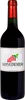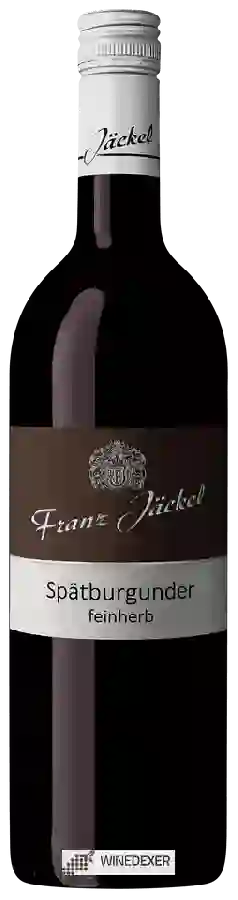
Winery Franz JäckelSpätburgunder Feinherb
 Red wine


In the mouth this red wine is a with a nice freshness.
This wine generally goes well with poultry, beef or veal.
Taste structure of the Spätburgunder Feinherb from the Winery Franz Jäckel
Light | Bold | |
Smooth | Tannic | |
Dry | Sweet | |
Soft | Acidic |
In the mouth the Spätburgunder Feinherb of Winery Franz Jäckel in the region of Nahe is a with a nice freshness.
Food and wine pairings with Spätburgunder Feinherb
Pairings that work perfectly with Spätburgunder Feinherb



Original food and wine pairings with Spätburgunder Feinherb

The Spätburgunder Feinherb of Winery Franz Jäckel matches generally quite well with dishes of beef, veal or game (deer, venison) such as recipes of southern beef meatballs, beef bourguignon with cookéo or rabbit with kriek and cherries.
Details and technical informations about Winery Franz Jäckel's Spätburgunder Feinherb.
Discover the grape variety: Petit brun
The petit brun is a black grape variety that is becoming rarer. It is found particularly in Provence, where it is one of the many other grape varieties that make up the reputation of this region. It is probably of Italian origin and is used to make the best red wines. It is known as "brun des Hautes Alpes". In order to be more productive, the vine needs to be pruned short and develops perfectly when it is well exposed. In France, Petit Brun is one of the secondary grape varieties used in the Palette appellations. The AOC Palette is considered the oldest in Provence. The wine made from petit brun is a dark red, particularly tannic. It gives off aromas of undergrowth and a floral scent. In the wines of Château Crémade, the petit brun gives them an exceptional subtlety.
Last vintages of this wine
The best vintages of Spätburgunder Feinherb from Winery Franz Jäckel are 0
Informations about the Winery Franz Jäckel
The Winery Franz Jäckel is one of of the world's greatest estates. It offers 41 wines for sale in the of Nahe to come and discover on site or to buy online.

The wine region of Nahe
Nahe is one of the smaller German wine regions, named after the Nahe river which joins the Rhein at Rheinhessen/bingen">Bingen. The viticultural carea here is characterised by dramatic topography with steep slopes and craggy outcrops of metamorphic rock. Like most of the regions on or near the Rhine, its most prestigious wines are made from Riesling. There are around 4,000 hectares (10,000 acres) of Vineyards, spread across seven Grosslagen (wine districts) and over 300 Einzellagen (individual vineyard sites).
The word of the wine: Dense
Rich and concentrated wine with tight tannins and a consistent body.