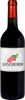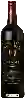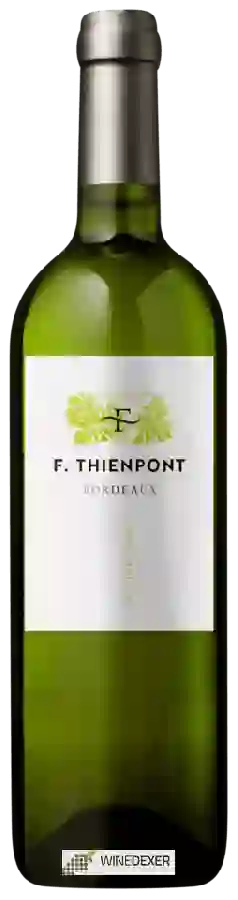
Winery F.ThienpontBordeaux Blanc
 White wine



In the mouth this white wine is a powerful with a nice freshness.
This wine generally goes well with pork, vegetarian or poultry.

Taste structure of the Bordeaux Blanc from the Winery F.Thienpont
Light | Bold | |
Dry | Sweet | |
Soft | Acidic |
In the mouth the Bordeaux Blanc of Winery F.Thienpont in the region of Bordeaux is a powerful with a nice freshness.
Food and wine pairings with Bordeaux Blanc
Pairings that work perfectly with Bordeaux Blanc



Original food and wine pairings with Bordeaux Blanc


The Bordeaux Blanc of Winery F.Thienpont matches generally quite well with dishes of pork, vegetarian or poultry such as recipes of baked dumplings, mushroom, bacon and gruyere quiche or savoury cake base and various fillings.
Details and technical informations about Winery F.Thienpont's Bordeaux Blanc.
Discover the grape variety: Ginestra
Simple, fresh dry whites with a pale golden colour, a supple palate and moderate acidity; undemonstrative aromas of citrus, white flowers (broom, giving the grape its name) and southern herbal notes. Rustic, airy style to drink young. Preserved for its heritage value, occasionally used in Campanian and Sicilian local blends. Rare Italian white grape grown mainly in Campania and southern Italy.
Last vintages of this wine
The best vintages of Bordeaux Blanc from Winery F.Thienpont are 2015, 2014, 2016, 2013
Informations about the Winery F.Thienpont
The Winery F.Thienpont is one of of the world's greatest estates. It offers 21 wines for sale in the of Bordeaux to come and discover on site or to buy online.

The wine region of Bordeaux
World-renowned age-worthy reds, led by round Merlot (plum, black fruit) or firm Cabernet Sauvignon (blackcurrant, cedar, graphite), blended with Cabernet Franc and Petit Verdot for tannic structure. Structured Médoc and Graves, velvety Saint-Émilion and Pomerol. Also crisp dry whites (Sauvignon/Sémillon) and opulent sweet Sauternes with honey and candied fruit. A 110,000 ha Gironde vineyard, 65 appellations, cradle of the 1855 classified growths.
The word of the wine: Deposit
Solid particles that can naturally coat the bottom of a bottle of wine. It is rather a guarantee that the wine has not been mistreated: in fact, to avoid the natural deposit, rather violent processes of filtration or cold passage (- 7 or - 8 °C) are used in order to precipitate the tartar (the small white crystals that some people confuse with crystallized sugar: just taste to dissuade you from it)