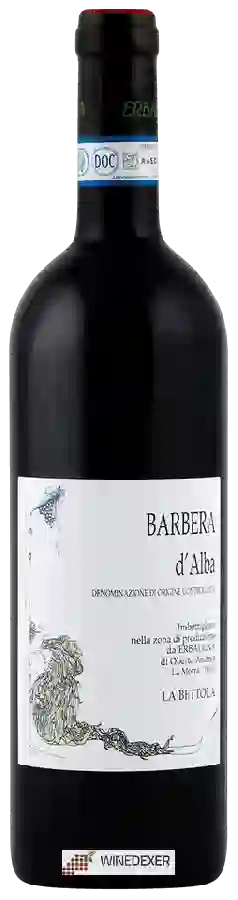
Winery ErbalunaLa Bettola Barbera d'Alba
 Red wine



In the mouth this red wine is a powerful with a nice freshness.
This wine generally goes well with pork, poultry or veal.

Taste structure of the La Bettola Barbera d'Alba from the Winery Erbaluna
Light | Bold | |
Smooth | Tannic | |
Dry | Sweet | |
Soft | Acidic |
In the mouth the La Bettola Barbera d'Alba of Winery Erbaluna in the region of Piedmont is a powerful with a nice freshness.
Wine flavors and olphactive analysis



On the nose the La Bettola Barbera d'Alba of Winery Erbaluna in the region of Piedmont often reveals types of flavors of non oak, earth or oak and sometimes also flavors of spices, red fruit or black fruit.
Food and wine pairings with La Bettola Barbera d'Alba
Pairings that work perfectly with La Bettola Barbera d'Alba



Original food and wine pairings with La Bettola Barbera d'Alba


The La Bettola Barbera d'Alba of Winery Erbaluna matches generally quite well with dishes of pasta, veal or pork such as recipes of pasta with tuna and tomato, tanjia or ideas for savoury pancake toppings.
Details and technical informations about Winery Erbaluna's La Bettola Barbera d'Alba.
Discover the grape variety: Piquepoul
Languedoc family with very high acidity, aromatic signature of southern France. Piquepoul Blanc gives lively, saline whites (Picpoul de Pinet AOC) with notes of citrus, white flowers and marine iodine, ideal with oysters. Piquepoul Noir gives fruity, fresh reds, one of the thirteen authorised varieties at Châteauneuf-du-Pape. French autochthonous variety from Languedoc, in white, black and grey versions.
Last vintages of this wine
The best vintages of La Bettola Barbera d'Alba from Winery Erbaluna are 2011, 2010, 2018, 2009 and 2008.
Informations about the Winery Erbaluna
The Winery Erbaluna is one of of the world's greatest estates. It offers 14 wines for sale in the of Barbera d'Alba to come and discover on site or to buy online.

The wine region of Barbera d'Alba
Premium Piedmontese Barbera around Alba (heart of the Langhe). Fleshier, more concentrated reds than neighbouring Asti, with signature notes of ripe black cherry, candied plum, violet and sweet spices, characteristic fresh acidity and round tannins. Frequent barrel ageing (chocolate, vanilla). Generous palate, accessible young, age-worthy Superiore versions.
The wine region of Piedmont
Kingdom of Nebbiolo: Barolo and Barbaresco DOCG, long-ageing reds with firm tannins and lively acidity, complex aromas of withered rose, sour cherry, tar, truffle and undergrowth. More accessible, tangy Barbera on red fruit, supple, crisp Dolcetto. Sweet, floral sparkling Moscato d'Asti, mineral, lemony Gavi (Cortese) white, round, almondy Arneis from Roero. 50,000 ha across the Langhe, Roero and Monferrato, UNESCO.
The word of the wine: Grand Cru
In Burgundy, the fourth and final level of classification (above the regional, communal and premier cru appellations), designating the wines produced on delimited plots of land (the climats) whose name alone constitutes the appellation. The climats classified as Grand Cru are 32 in the Côte d'Or plus one in Chablis which is divided into 7 distinct climats. Representing barely 1.5% of the production, the Grand Crus are the aristocracy of Burgundy wines.