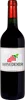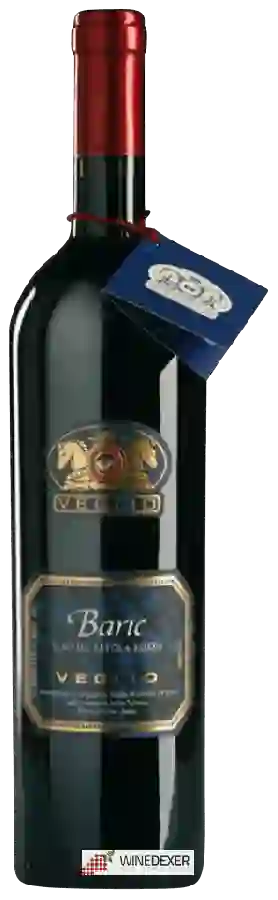
Winery VeglioBaric Rosso
 Red wine


In the mouth this red wine is a powerful.
This wine generally goes well with beef, game (deer, venison) or lamb.
Taste structure of the Baric Rosso from the Winery Veglio
Light | Bold | |
Smooth | Tannic | |
Dry | Sweet | |
Soft | Acidic |
In the mouth the Baric Rosso of Winery Veglio in the region of Vino da Tavola is a powerful.
Food and wine pairings with Baric Rosso
Pairings that work perfectly with Baric Rosso



Original food and wine pairings with Baric Rosso

The Baric Rosso of Winery Veglio matches generally quite well with dishes of beef, pasta or lamb such as recipes of beef mironton, cannelloni with parma ham or lamb keftas.
Details and technical informations about Winery Veglio's Baric Rosso.
Discover the grape variety: Nebbiolo
A very old grape variety grown in the Italian Piedmont. It has a great resemblance with the Freisa, which also comes from the same Italian region. Among the various massal selections made in Italy, we find lampia, michet and rosé. It can be found in Italy, Austria, Bulgaria, Cyprus, Greece, Mexico, the United States (California), Australia, etc. In France, it is practically unknown, perhaps because it is a delicate and demanding grape variety with, among other things, a fairly long phenological cycle.
Last vintages of this wine
The best vintages of Baric Rosso from Winery Veglio are 0
Informations about the Winery Veglio
The Winery Veglio is one of of the world's great estates. It offers 26 wines for sale in the of Vino da Tavola to come and discover on site or to buy online.

The wine region of Vino da Tavola
Vino da Tavola was the most basic classification of Italian wines. It is now renamed simply "Vino" and appears on labels as Vino d'Italia. The original name literally means "table wine" as opposed to premium wines from specific geographical locations (see EU wine label). In May 2011, the first legal steps were taken to abolish the Vino da Tavola category, in favor of a New classification of wines called simply Vino.
The word of the wine: Chaptalization
The addition of sugar at the time of fermentation of the must, an ancient practice, but theorized by Jean-Antoine Chaptal at the dawn of the 19th century. The sugar is transformed into alcohol and allows the natural degree of the wine to be raised in a weak or cold year, or - more questionably - when the winegrower has a harvest that is too large to obtain good maturity.