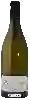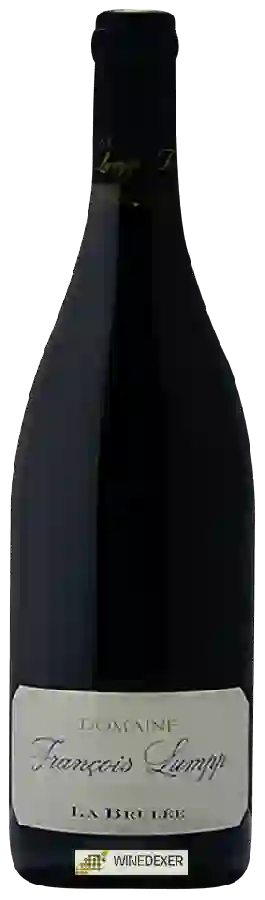
Domaine François LumppLa Brûlée
 Red wine


This wine generally goes well with pork, poultry or veal.
The La Brûlée of the Domaine François Lumpp is in the top 30 of wines of Givry Premier Cru.

Wine flavors and olphactive analysis

On the nose the La Brûlée of Domaine François Lumpp in the region of Burgundy often reveals types of flavors of oaky, oak or red fruit.
Food and wine pairings with La Brûlée
Pairings that work perfectly with La Brûlée



Original food and wine pairings with La Brûlée


The La Brûlée of Domaine François Lumpp matches generally quite well with dishes of veal, pork or game (deer, venison) such as recipes of dafina, ham croquette with purée or stuffed guinea fowl in the oven.
Details and technical informations about Domaine François Lumpp's La Brûlée.
Discover the grape variety: Pinot noir
Elegant reds, light in colour with silky tannins, showing strawberry, cherry and raspberry aromas, evolving to forest floor, mushroom and spice with age. Fresh acidity, delicate finish. Star of the Côte d'Or (Romanée-Conti, Chambertin, Volnay), pillar of Champagne (Blanc de Noirs) and signature of Oregon, Central Otago and Sonoma Coast. An early-ripening Burgundian variety, one of the world's greatest.
Last vintages of this wine

The best vintages of La Brûlée from Domaine François Lumpp are 2016, 2014, 2012, 2013 and 2011.
Informations about the Domaine François Lumpp
The Domaine François Lumpp is one of of the world's greatest estates. It offers 15 wines for sale in the of Givry Premier Cru to come and discover on site or to buy online.

The wine region of Givry Premier Cru
38 Premier Cru climates in the Côte Chalonnaise (Saône-et-Loire) covering Givry, Dracy-le-Fort and Jambles: mainly Pinot Noir and Chardonnay. Reds with carmine to purple robe, red and black fruit aromas, spices and floral notes. Tannic in youth, rounding after 3-5 years. Top climates Le Paradis, Cellier aux Moines, Clos du Cras Long, Servoisine.
The wine region of Burgundy
Absolute reference for great terroir wines: opulent, mineral Chardonnay in whites (chiselled Chablis, buttery Meursault, majestic Montrachet), fine and silky Pinot Noir in reds (full-bodied Gevrey, structured Pommard, delicate Volnay). Exceptional age-worthy wines with complex notes - red fruits, undergrowth, butter, hazelnut. Some lively Aligoté and light Gamay (Mâconnais). 29,500 ha, 84 tiered AOCs (Régionale, Village, 1er Cru, Grand Cru), 1,247 UNESCO Climats.
The word of the wine: White winemaking
White wines are obtained by fermentation of the juice after pressing. A pre-fermentation maceration is sometimes practiced to extract the aromatic substances from the skins. White wines are normally made from white grapes, but can also be made from red grapes (blanc de noirs). The grapes are then pressed as soon as they arrive at the vat house without maceration in order to prevent the colouring matter contained in the skins from "staining" the wine.