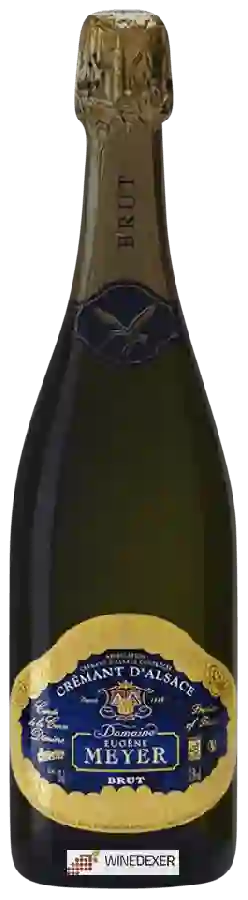
Domaine Eugène MeyerCrémant d'Alsace Brut
 Sparkling wine



In the mouth this sparkling wine is a powerful with a nice vivacity and a fine and pleasant bubble.
This wine generally goes well with poultry, appetizers and snacks or lean fish.

Taste structure of the Crémant d'Alsace Brut from the Domaine Eugène Meyer
Light | Bold | |
Soft | Acidic | |
Gentle | Fizzy |
In the mouth the Crémant d'Alsace Brut of Domaine Eugène Meyer in the region of Alsace is a powerful with a nice vivacity and a fine and pleasant bubble.
Wine flavors and olphactive analysis

On the nose the Crémant d'Alsace Brut of Domaine Eugène Meyer in the region of Alsace often reveals types of flavors of apricot, microbio or tree fruit.
Food and wine pairings with Crémant d'Alsace Brut
Pairings that work perfectly with Crémant d'Alsace Brut



Original food and wine pairings with Crémant d'Alsace Brut


The Crémant d'Alsace Brut of Domaine Eugène Meyer matches generally quite well with dishes of shellfish, poultry or appetizers and snacks such as recipes of sauerkraut of the sea in casserole, couscous chicken and merguez or melon and cucumber gazpacho.
Details and technical informations about Domaine Eugène Meyer's Crémant d'Alsace Brut.
Discover the grape variety: Bogazkere
Powerful, tannic reds with an almost black ink-dark robe, firm, astringent tannins and a dense palate, showing intense aromas of blackberry, blackcurrant, black plum, leather, spices, tobacco and balsamic notes. Fine ageing potential. Star of the great Turkish reds on the arid terroirs of south-east Anatolia (Diyarbakır region, Tigris valley), often blended with öküzgözü to soften its structure. Autochthonous Anatolian variety, its name means "throat-burner" in Turkish.
Informations about the Domaine Eugène Meyer
The Domaine Eugène Meyer is one of of the world's greatest estates. It offers 37 wines for sale in the of Alsace to come and discover on site or to buy online.

The wine region of Alsace
Capital of great French aromatic whites, most often dry and single-varietal. Straight, mineral Riesling (lemon, gunflint), opulent, exuberant Gewurztraminer (lychee, rose, spices), round, smoky Pinot Gris, floral, crisp Muscat, supple Pinot Blanc. Fine, fruity Crémants d'Alsace, exceptional sweet Vendanges Tardives and Sélection de Grains Nobles. 15,500 ha at the foot of the Vosges on varied soils, 51 Grands Crus since 1975.
The word of the wine: Rancio
Odour and taste characteristic of certain wines that have undergone oxidative maturation, i.e. in contact with oxygen (vin jaune du Jura, dry rancio du Roussillon, maury, banyuls, rivesaltes, etc.).


