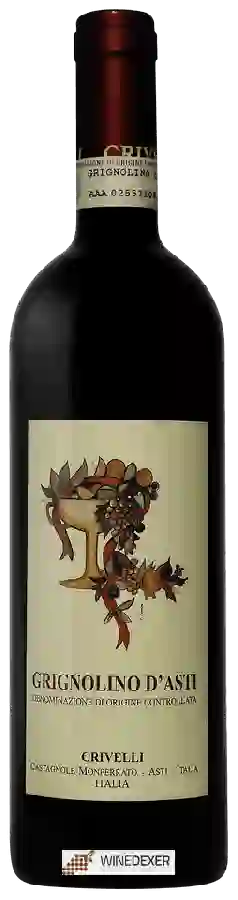
Winery CrivelliGrignolino d'Asti
 White wine



In the mouth this white wine is a powerful with a nice freshness.
This wine generally goes well with lean fish, shellfish or mature and hard cheese.

Taste structure of the Grignolino d'Asti from the Winery Crivelli
Light | Bold | |
Dry | Sweet | |
Soft | Acidic |
In the mouth the Grignolino d'Asti of Winery Crivelli in the region of Piedmont is a powerful with a nice freshness.
Wine flavors and olphactive analysis

On the nose the Grignolino d'Asti of Winery Crivelli in the region of Piedmont often reveals types of flavors of spices, red fruit or black fruit.
Food and wine pairings with Grignolino d'Asti
Pairings that work perfectly with Grignolino d'Asti



Original food and wine pairings with Grignolino d'Asti


The Grignolino d'Asti of Winery Crivelli matches generally quite well with dishes of pasta, shellfish or mature and hard cheese such as recipes of pasta with tuna and tomato, blanquette of monkfish and scallops or leek, bacon and beaufort pie.
Details and technical informations about Winery Crivelli's Grignolino d'Asti.
Discover the grape variety: Grignolino
Light, elegant reds with a clear ruby robe (often compared to Pinot Noir), fine but firm tannins and lively acidity, with aromas of red cherry, raspberry, rose, spice, white pepper and herbal notes. Airy palate, slightly bitter finish. Star of Grignolino d'Asti DOC and Grignolino del Monferrato Casalese DOC in the Piedmontese hills. This autochthonous Piedmontese variety takes its name from grignole (the many pips it contains).
Last vintages of this wine
The best vintages of Grignolino d'Asti from Winery Crivelli are 2013, 2012, 0, 2018 and 2017.
Informations about the Winery Crivelli
The Winery Crivelli is one of of the world's greatest estates. It offers 7 wines for sale in the of Grignolino d'Asti to come and discover on site or to buy online.

The wine region of Grignolino d'Asti
Piedmont DOC on the hills of Monferrato, calcareous and sandy soils. Grignolino is the unique native signature variety (from grignole, "many pips" in Piedmontese). Reds atypical for Piedmont: pale ruby robe evolving towards orange with wild strawberry, red cherry, raspberry, rose, sweet spices and a herbaceous touch, fine, slightly austere tannins and a delicately bitter finish — airy, fresh and elegant style. To drink young, contrasting with neighbouring Barolo and Barbaresco.
The wine region of Piedmont
Kingdom of Nebbiolo: Barolo and Barbaresco DOCG, long-ageing reds with firm tannins and lively acidity, complex aromas of withered rose, sour cherry, tar, truffle and undergrowth. More accessible, tangy Barbera on red fruit, supple, crisp Dolcetto. Sweet, floral sparkling Moscato d'Asti, mineral, lemony Gavi (Cortese) white, round, almondy Arneis from Roero. 50,000 ha across the Langhe, Roero and Monferrato, UNESCO.
The word of the wine: Tanin
A natural compound contained in the skin of the grape, the seed or the woody part of the bunch, the stalk. The maceration of red wines allows the extraction of tannins, which give the texture, the solidity and also the mellowness when the tannins are "ripe". The winemaker seeks above all to extract the tannins from the skin, the ripest and most noble. The tannins of the seed or stalk, which are "greener", especially in average years, give the wine hardness and astringency. The wines of Bordeaux (based on Cabernet and Merlot) are full of tannins, those of Burgundy much less so, with Pinot Noir containing little.