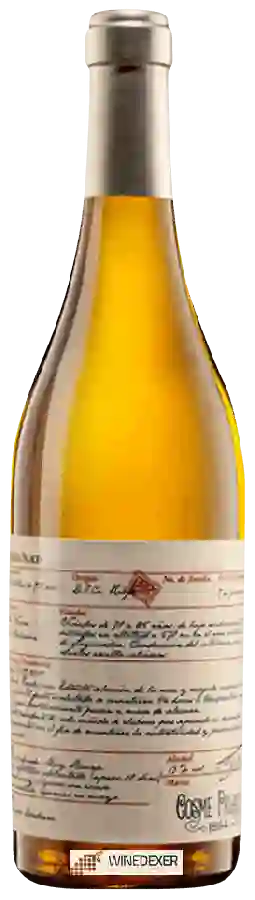
Winery Cosme Palacio1894 Blanco
 White wine


In the mouth this white wine is a powerful with a nice freshness.
This wine generally goes well with appetizers and snacks, lean fish or shellfish.
Taste structure of the 1894 Blanco from the Winery Cosme Palacio
Light | Bold | |
Dry | Sweet | |
Soft | Acidic |
In the mouth the 1894 Blanco of Winery Cosme Palacio in the region of Rioja is a powerful with a nice freshness.
Wine flavors and olphactive analysis





On the nose the 1894 Blanco of Winery Cosme Palacio in the region of Rioja often reveals types of flavors of non oak, earth or oak and sometimes also flavors of tree fruit, spices.
Food and wine pairings with 1894 Blanco
Pairings that work perfectly with 1894 Blanco



Original food and wine pairings with 1894 Blanco

The 1894 Blanco of Winery Cosme Palacio matches generally quite well with dishes of shellfish, appetizers and snacks or lean fish such as recipes of creamy risotto with scallops, goat's cheese sandwich with honey or zohra's fish tagine.
Details and technical informations about Winery Cosme Palacio's 1894 Blanco.
Discover the grape variety: Carminoir
Intraspecific crossing between pinot noir and cabernet-sauvignon obtained in 1982 at the Federal Research Station Agroscope Changins in Wadenswil (Switzerland). It can be found in Switzerland, Germany, Belgium, ... in France it is very little known.
Last vintages of this wine

The best vintages of 1894 Blanco from Winery Cosme Palacio are 2015, 2014, 2007, 2010 and 0.
Informations about the Winery Cosme Palacio
The Winery Cosme Palacio is one of of the world's greatest estates. It offers 7 wines for sale in the of Rioja to come and discover on site or to buy online.

The wine region of Rioja
Rioja, in northern Spain, is best known for its berry-flavored, barrel-aged red wines made from Tempranillo and Garnacha. It is probably the leading wine region in Spain. It is certainly the most famous, rivaling only Jerez. The Vineyards follow the course of the Ebro for a hundred kilometres between the towns of Haro and Alfaro.
The word of the wine: Final
A more or less lasting impression that is felt in the mouth once the wine has been swallowed (or spat out in the case of a professional tasting). The finish can be short or persistent.