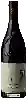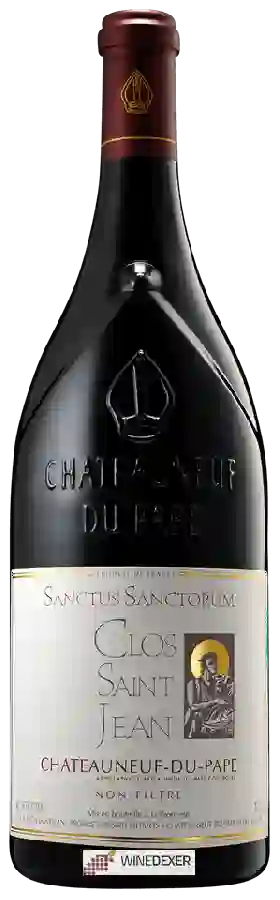
Clos Saint JeanChateauneuf-du-Pape Sanctus Sanctorum
 Red wine


In the mouth this red wine is a powerful with a nice freshness.
This wine generally goes well with pork, poultry or lamb.
Taste structure of the Chateauneuf-du-Pape Sanctus Sanctorum from the Clos Saint Jean
Light | Bold | |
Smooth | Tannic | |
Dry | Sweet | |
Soft | Acidic |
In the mouth the Chateauneuf-du-Pape Sanctus Sanctorum of Clos Saint Jean in the region of Rhone Valley is a powerful with a nice freshness.
Wine flavors and olphactive analysis




On the nose the Chateauneuf-du-Pape Sanctus Sanctorum of Clos Saint Jean in the region of Rhone Valley often reveals types of flavors of pepper, non oak or oak and sometimes also flavors of spices, red fruit.
Food and wine pairings with Chateauneuf-du-Pape Sanctus Sanctorum
Pairings that work perfectly with Chateauneuf-du-Pape Sanctus Sanctorum



Original food and wine pairings with Chateauneuf-du-Pape Sanctus Sanctorum
The Chateauneuf-du-Pape Sanctus Sanctorum of Clos Saint Jean matches generally quite well with dishes of lamb, pork or poultry such as recipes of lamb tagine with apricots, new york hot dog or chicken with olives in a couscousier.
Details and technical informations about Clos Saint Jean's Chateauneuf-du-Pape Sanctus Sanctorum.
Discover the grape variety: Bertille Seyve 450
Interspecific crossing carried out by Bertille Seyve (1864-1944) between the 2003 Seibel and the Noah, which it closely resembles. It was mainly cultivated in the western departments of France, but also in the Rhône valley and the Ain.
Last vintages of this wine

The best vintages of Chateauneuf-du-Pape Sanctus Sanctorum from Clos Saint Jean are 2016, 2015, 2012, 2009
Informations about the Clos Saint Jean
The Clos Saint Jean is one of of the world's greatest estates. It offers 9 wines for sale in the of Châteauneuf-du-Pape to come and discover on site or to buy online.

The wine region of Châteauneuf-du-Pape
The wine region of Châteauneuf-du-Pape is located in the region of Rhône méridional of Rhone Valley of France. Wineries and vineyards like the Domaine Pegau or the Château Rayas produce mainly wines red and white. The most planted grape varieties in the region of Châteauneuf-du-Pape are Mourvèdre, Roussanne and Clairette, they are then used in wines in blends or as a single variety. On the nose of Châteauneuf-du-Pape often reveals types of flavors of iron, chestnut or red licorice and sometimes also flavors of tarragon, pencil shavings or cured meat.
The wine region of Rhone Valley
The Rhone Valley is a key wine-producing region in Southeastern France. It follows the North-south course of the Rhône for nearly 240 km, from Lyon to the Rhône delta (Bouches-du-Rhône), near the Mediterranean coast. The Length of the valley means that Rhône wines are the product of a wide variety of soil types and mesoclimates. The viticultural areas of the region cover such a distance that there is a widely accepted division between its northern and southern parts.
The word of the wine: Sweet
Wine with a slightly sickening sweetness.