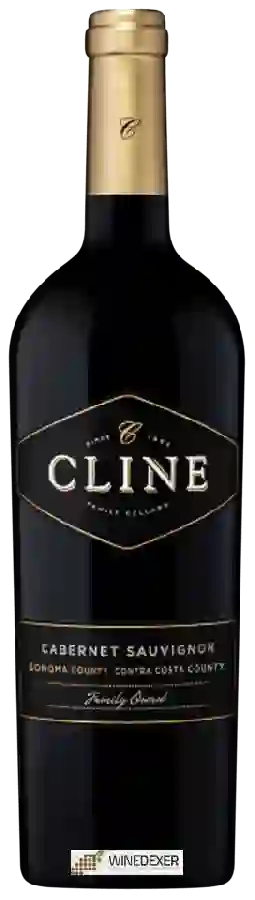
Winery ClineCabernet Sauvignon
 Red wine



This wine is composed of 100% of the grape variety Cabernet Sauvignon.
In the mouth this red wine is a powerful with a nice balance between acidity and tannins.
This wine generally goes well with poultry, beef or game (deer, venison).

Taste structure of the Cabernet Sauvignon from the Winery Cline
Light | Bold | |
Smooth | Tannic | |
Dry | Sweet | |
Soft | Acidic |
In the mouth the Cabernet Sauvignon of Winery Cline in the region of California is a powerful with a nice balance between acidity and tannins.
Wine flavors and olphactive analysis





On the nose the Cabernet Sauvignon of Winery Cline in the region of California often reveals types of flavors of non oak, earth or oak and sometimes also flavors of spices, red fruit or black fruit.
Food and wine pairings with Cabernet Sauvignon
Pairings that work perfectly with Cabernet Sauvignon



Original food and wine pairings with Cabernet Sauvignon

The Cabernet Sauvignon of Winery Cline matches generally quite well with dishes of beef, lamb or game (deer, venison) such as recipes of beef kidney, lamb curl or rabbit with mustard in foil.
Details and technical informations about Winery Cline's Cabernet Sauvignon.
Discover the grape variety: Cabernet-Sauvignon
Structured, tannic reds, deeply coloured, with aromas of blackcurrant, blackberry, cedar, tobacco and graphite, underpinned by firm acidity and fine ageing potential. Cornerstone of the great Médoc estates (Pauillac, Saint-Estèphe, Saint-Julien) and signature of Napa Valley, Coonawarra and Maipo. The world's most planted red variety, a natural cross of Cabernet Franc x Sauvignon Blanc born in Bordeaux.
Last vintages of this wine
The best vintages of Cabernet Sauvignon from Winery Cline are 2018, 0, 2017
Informations about the Winery Cline
The Winery Cline is one of of the world's great estates. It offers 77 wines for sale in the of Contra Costa County to come and discover on site or to buy online.

The wine region of Contra Costa County
Historic AVA of San Francisco Bay with century-old vines on deep sands (Brentwood, Oakley): Zinfandel signature from old vines planted 100+ years ago (Evangelho, Bigelow, Mazzoni) — concentrated and earthy reds with intense black fruits, spices and firm tannins. Robust and structured patrimonial Mourvèdre (Mataro) and Carignan. Draining sands restricting yields, small berries with thick skins. Also Petite Sirah.
The wine region of California
Powerful, sunny reds: dense Napa Cabernet Sauvignon (blackcurrant, chocolate, tobacco, ample tannins), spicy, jammy Zinfandel from the Sierra Foothills, silky red-fruited Pinot Noir on the cool coast (Sonoma, Russian River, Central Coast). Opulent, buttery Chardonnay, notes of yellow fruit and vanilla. Varied climate, from the hot interior to the Pacific-cooled coast. 80% of US production, 139 AVAs including Napa (1st AVA, 1981).
The word of the wine: Tanin
A natural compound contained in the skin of the grape, the seed or the woody part of the bunch, the stalk. The maceration of red wines allows the extraction of tannins, which give the texture, the solidity and also the mellowness when the tannins are "ripe". The winemaker seeks above all to extract the tannins from the skin, the ripest and most noble. The tannins of the seed or stalk, which are "greener", especially in average years, give the wine hardness and astringency. The wines of Bordeaux (based on Cabernet and Merlot) are full of tannins, those of Burgundy much less so, with Pinot Noir containing little.


