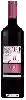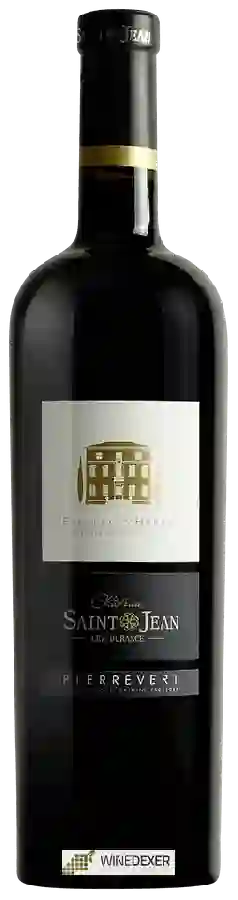
Chateau Saint JeanPimayon Pierrevert Rouge
 Red wine


This wine generally goes well with beef, lamb or mature and hard cheese.

Food and wine pairings with Pimayon Pierrevert Rouge
Pairings that work perfectly with Pimayon Pierrevert Rouge



Original food and wine pairings with Pimayon Pierrevert Rouge

The Pimayon Pierrevert Rouge of Chateau Saint Jean matches generally quite well with dishes of beef, lamb or spicy food such as recipes of brazilian feijoada, moroccan lamb stew or couscous from the sea.
Details and technical informations about Chateau Saint Jean's Pimayon Pierrevert Rouge.
Discover the grape variety: Verjus
A very high-acid variety grown not for wine but for verjuice production — the tart unripe grape juice used in traditional cooking to acidify sauces and meats. Now virtually extinct, it bears witness to French gastronomic and viticultural heritage and is preserved in varietal collections for its historical interest. A historic French white grape specific to medieval verjuice.
Last vintages of this wine

The best vintages of Pimayon Pierrevert Rouge from Chateau Saint Jean are 2017, 2018, 2015, 2014
Informations about the Chateau Saint Jean
The Chateau Saint Jean is one of of the world's greatest estates. It offers 24 wines for sale in the of Coteaux de Pierrevert to come and discover on site or to buy online.

The wine region of Coteaux de Pierrevert
Provençal AOC of the Alpes-de-Haute-Provence (1998) around Manosque, the highest vineyard of Provence (400–500 m on the Durance hillsides), cool Mediterranean interior climate. Rosés (~53%) based on Grenache and Syrah with Cinsault and Mourvèdre: pale and crunchy with strawberry, raspberry, citrus, garrigue and floral notes, fresh altitude acidity — summery aperitif. Supple, fruity reds. Lively whites from Vermentino, Clairette and Marsanne.
The wine region of Provence
World capital of dry, refined rosé (~90% of production). Pale rose-petal colour, delicate nose of fresh red fruits (strawberry, raspberry, redcurrant), citrus (pink grapefruit), white flowers and a mineral touch, taut and thirst-quenching palate — the Mediterranean aperitif par excellence. Blends of Grenache, Cinsault, Syrah, Tibouren and Mourvèdre. Fleshy Bandol reds from Mourvèdre (leather, garrigue, age-worthy), straight Cassis whites.
The word of the wine: Grand Cru
In Burgundy, the fourth and final level of classification (above the regional, communal and premier cru appellations), designating the wines produced on delimited plots of land (the climats) whose name alone constitutes the appellation. The climats classified as Grand Cru are 32 in the Côte d'Or plus one in Chablis which is divided into 7 distinct climats. Representing barely 1.5% of the production, the Grand Crus are the aristocracy of Burgundy wines.