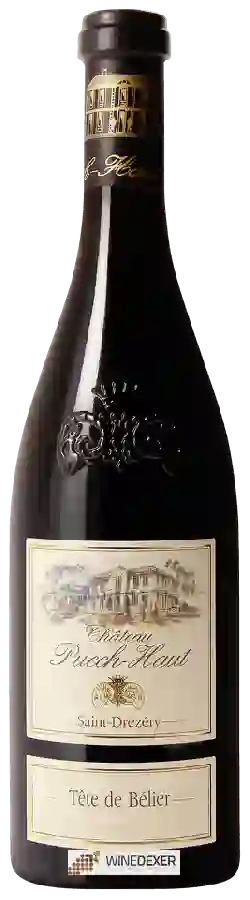
Château Puech-HautTête de Bélier Saint-Drézéry Rouge
 Red wine


This wine is a blend of 5 varietals which are the Carignan, the Grenache, the Mourvèdre, the Syrah and the Grenache noir.
In the mouth this red wine is a powerful with a nice balance between acidity and tannins.
This wine generally goes well with beef, veal or pasta.
Taste structure of the Tête de Bélier Saint-Drézéry Rouge from the Château Puech-Haut
Light | Bold | |
Smooth | Tannic | |
Dry | Sweet | |
Soft | Acidic |
In the mouth the Tête de Bélier Saint-Drézéry Rouge of Château Puech-Haut in the region of Languedoc-Roussillon is a powerful with a nice balance between acidity and tannins.
Wine flavors and olphactive analysis






On the nose the Tête de Bélier Saint-Drézéry Rouge of Château Puech-Haut in the region of Languedoc-Roussillon often reveals types of flavors of cream, cherry or citrus and sometimes also flavors of smoke, peach or earthy.
Food and wine pairings with Tête de Bélier Saint-Drézéry Rouge
Pairings that work perfectly with Tête de Bélier Saint-Drézéry Rouge



Original food and wine pairings with Tête de Bélier Saint-Drézéry Rouge
The Tête de Bélier Saint-Drézéry Rouge of Château Puech-Haut matches generally quite well with dishes of beef, veal or pasta such as recipes of beef marengo "my mom" style, roast pork with prunes or pasta with goat cheese, thyme and bacon.
Details and technical informations about Château Puech-Haut's Tête de Bélier Saint-Drézéry Rouge.
Discover the grape variety: Carignan
Mainly cultivated in the Languedoc region, carignan originates from Spain. Because of its very resistant branches, it is often called hardwood. Its bunches are quite large. They are compact and winged with a lignified stalk. The berries are spherical in shape and take on a bluish-black colour. Carignan has a total of 25 approved clones, the best known of which are 274, 65 and 9. The carignan buds at the beginning of June and is protected from spring frosts. It does not reach maturity until the third period. Also, this grape variety needs warmth and sunshine. It appreciates dry and not very fertile soils. Carignan vines can live for more than 100 years. Those that are more than 30 years old produce a better wine. This wine is well coloured. It is generous and powerful at the same time. Pepper, cherry, blackberry, banana, raspberry, almond, prune and violet are some of the aromas that this grape variety gives off.
Last vintages of this wine
The best vintages of Tête de Bélier Saint-Drézéry Rouge from Château Puech-Haut are 2018, 2019, 2017, 2022 and 2021.
Informations about the Château Puech-Haut
The Château Puech-Haut is one of of the world's greatest estates. It offers 52 wines for sale in the of Saint-Drézéry to come and discover on site or to buy online.

The wine region of Saint-Drézéry
The wine region of Saint-Drézéry is located in the region of Languedoc of Languedoc-Roussillon of France. Wineries and vineyards like the Château Puech-Haut or the Château Puech-Haut produce mainly wines red, pink and white. The most planted grape varieties in the region of Saint-Drézéry are Mourvèdre, Marsanne and Roussanne, they are then used in wines in blends or as a single variety. On the nose of Saint-Drézéry often reveals types of flavors of earth, cranberry or cassis and sometimes also flavors of clove, juniper or mushroom.
The wine region of Languedoc-Roussillon
Languedoc (formerly Coteaux du Languedoc) is a key appellation used in the Languedoc-Roussillon wine region of southern France. It covers Dry table wines of all three colors (red, white and rosé) from the entire region, but leaves Sweet and Sparkling wines to other more specialized appellations. About 75% of all Languedoc wines are red, with the remaining 25% split roughly down the middle between whites and rosés. The appellation covers most of the Languedoc region and almost a third of all the vineyards in France.
The word of the wine: Astringency
Chemical stimulation that tightens the mucous membranes of the mouth and causes a sensation of harshness, which is characteristic of the presence of tannins. With time, the tannins lose their harshness and become softer.