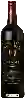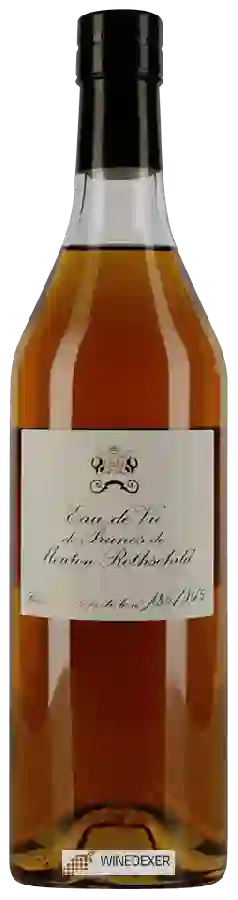
Château Mouton RothschildEau-de-Vie de Prunes
 Sweet wine


This wine generally goes well with
The Eau-de-Vie de Prunes of the Château Mouton Rothschild is in the top 80 of wines of France and in the top 5 of wines of Bordeaux.
Wine flavors and olphactive analysis



On the nose the Eau-de-Vie de Prunes of Château Mouton Rothschild in the region of Bordeaux often reveals types of flavors of earth, oak or spices.
Details and technical informations about Château Mouton Rothschild's Eau-de-Vie de Prunes.
Discover the grape variety: Corvina
Its precise origin is unknown, it has been cultivated for a very long time in northern Italy. It can be found in Switzerland, Australia, Argentina, ... in France it is almost unknown. It should not be confused with the Corvinone, another Italian grape variety. It should be noted that the Corvina is related to the Rondinella and the Refosco dal Peduncolo rosso.
Last vintages of this wine
The best vintages of Eau-de-Vie de Prunes from Château Mouton Rothschild are 2001, 1987, 1995, 1988
Informations about the Château Mouton Rothschild
The Château Mouton Rothschild is one of of the world's greatest estates. It offers 7 wines for sale in the of Bordeaux to come and discover on site or to buy online.

The wine region of Bordeaux
Bordeaux, in southwestern France, is one of the most famous, prestigious and prolific wine regions in the world. The majority of Bordeaux wines (nearly 90% of the production Volume) are the Dry, medium and Full-bodied red Bordeaux blends for which it is famous. The finest (and most expensive) are the wines of the great châteaux of Haut-Médoc and the right bank appellations of Saint-Émilion and Pomerol. The former focuses (at the highest level) on Cabernet Sauvignon, the latter on Merlot.
The word of the wine: Heady
Said of a wine rich in alcohol, powerful and expressive.