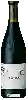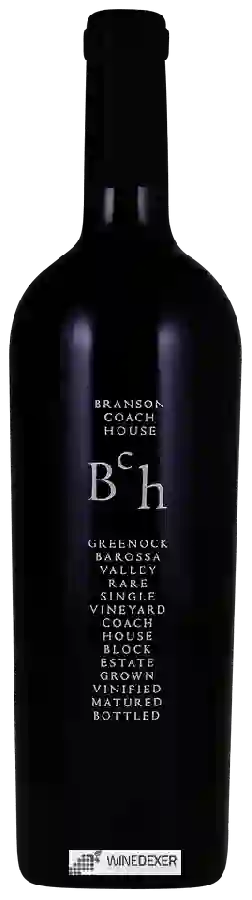
Winery Branson Coach HouseRare Single Vineyard Shiraz
 Red wine


In the mouth this red wine is a powerful with a nice balance between acidity and tannins.
This wine generally goes well with poultry, beef or game (deer, venison).
The Rare Single Vineyard Shiraz of the Winery Branson Coach House is in the top 90 of wines of Australia and in the top 20 of wines of Barossa Valley.
Taste structure of the Rare Single Vineyard Shiraz from the Winery Branson Coach House
Light | Bold | |
Smooth | Tannic | |
Dry | Sweet | |
Soft | Acidic |
In the mouth the Rare Single Vineyard Shiraz of Winery Branson Coach House in the region of Australie du Sud is a powerful with a nice balance between acidity and tannins.
Wine flavors and olphactive analysis




On the nose the Rare Single Vineyard Shiraz of Winery Branson Coach House in the region of Australie du Sud often reveals types of flavors of oaky, blackberry or blueberry and sometimes also flavors of vanilla, coffee or plum.
Food and wine pairings with Rare Single Vineyard Shiraz
Pairings that work perfectly with Rare Single Vineyard Shiraz



Original food and wine pairings with Rare Single Vineyard Shiraz

The Rare Single Vineyard Shiraz of Winery Branson Coach House matches generally quite well with dishes of beef, lamb or game (deer, venison) such as recipes of burger roll, lamb stew with melting peppers or roast pork confit.
Details and technical informations about Winery Branson Coach House's Rare Single Vineyard Shiraz.
Discover the grape variety: Couston
Couston noir is a grape variety that originated in France (Languedoc). It produces a variety of grape specially used for wine making. It is rare to find this grape to eat on our tables. This variety of grape is characterized by small bunches, and small grapes. The Couston noir can be found cultivated in these vineyards: Provence & Corsica, Rhone Valley, South West.
Last vintages of this wine

The best vintages of Rare Single Vineyard Shiraz from Winery Branson Coach House are 2002, 2005, 2004, 2003
Informations about the Winery Branson Coach House
The Winery Branson Coach House is one of of the world's greatest estates. It offers 4 wines for sale in the of Barossa Valley to come and discover on site or to buy online.

The wine region of Barossa Valley
The wine region of Barossa Valley is located in the region of Barossa of Australie du Sud of Australia. We currently count 613 estates and châteaux in the of Barossa Valley, producing 2290 different wines in conventional, organic and biodynamic agriculture. The wines of Barossa Valley go well with generally quite well with dishes .
The wine region of Australie du Sud
SouthAustralia is one of Australia's six states, located (as the name suggests) in the south of the vast island continent. It's the engine room of the Australian wine industry, responsible for about half of the country's total production each year. But there's more to the region than quantity - countless high-quality wines are produced here, most from the region's signature Grape, Shiraz. These include such fine, collectible wines as Penfolds Grange, Henschke Hill of Grace, Torbreck The Laird and d'Arenberg The Dead Arm.
The word of the wine: Hairy
A sensual and complete wine that leaves a sensation of balance and fullness in the mouth.