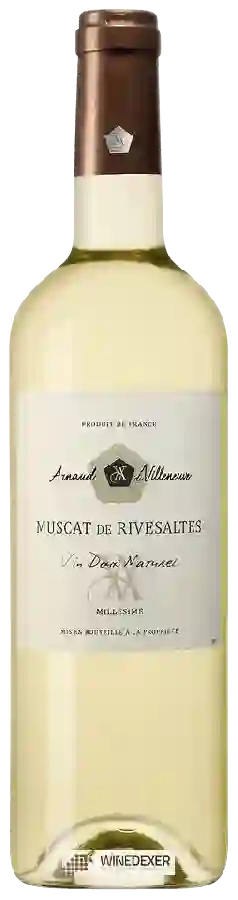
Winery Arnaud de VilleneuveMuscat de Rivesaltes Millesime
 Natural sweet wine


This wine generally goes well with spicy food and sweet desserts.

Food and wine pairings with Muscat de Rivesaltes Millesime
Pairings that work perfectly with Muscat de Rivesaltes Millesime


Original food and wine pairings with Muscat de Rivesaltes Millesime
The Muscat de Rivesaltes Millesime of Winery Arnaud de Villeneuve matches generally quite well with dishes of spicy food or sweet desserts such as recipes of butternut soufflé or tarte tatin.
Details and technical informations about Winery Arnaud de Villeneuve's Muscat de Rivesaltes Millesime.
Discover the grape variety: Arbois
Supple dry whites with a pale golden robe, an airy palate with moderate acidity and discreet signature aromas of citrus, white-fleshed fruits and Loire white flowers. Also as sparkling. Enters into blends of Touraine, Cheverny, Valençay AOC and Crémant de Loire. Not to be confused with the Jura Arbois vineyard. French autochthonous white grape from Touraine, grown mainly in Loir-et-Cher.
Last vintages of this wine

The best vintages of Muscat de Rivesaltes Millesime from Winery Arnaud de Villeneuve are 2018, 2017, 2016, 2011 and 2015.
Informations about the Winery Arnaud de Villeneuve
The Winery Arnaud de Villeneuve is one of of the world's greatest estates. It offers 82 wines for sale in the of Muscat de Rivesaltes to come and discover on site or to buy online.

The wine region of Muscat de Rivesaltes
Star AOC of Roussillon's Vins Doux Naturels: Muscat a Petits Grains and Muscat of Alexandria as signatures in equal parts in sweet whites — pale gold robe with green or pinkish glints, dazzling signature aromas of peach, lemon, mango, fresh grape, rose and mint, unctuous palate preserved by mutage with alcohol. Amber evolution with age toward honey, candied apricot and spices. AOC, ~4,400 ha across 99 communes, varied soils (granite, schist, limestone), Mediterranean and Muscat de Noel.
The wine region of Languedoc-Roussillon
Largest single French vineyard, dominated by sunny, generous reds. Spicy Syrah, candied Grenache (ripe fruit, garrigue), structured Carignan, deep Mourvèdre, supple Cinsault. Stars: structured Corbières, Minervois, Faugères, Saint-Chinian; round Côtes-du-Roussillon. Legendary vins doux naturels: Banyuls and Maury (fortified Grenache) with notes of cocoa, fig, prune.
The word of the wine: Blanc de blancs (champagne)
Champagne made only from the Chardonnay grape. The expression has been somewhat overused by the intensive use made of it by certain large distributors of white table wines (or sparkling wines) who were thus seeking to promote their product.


