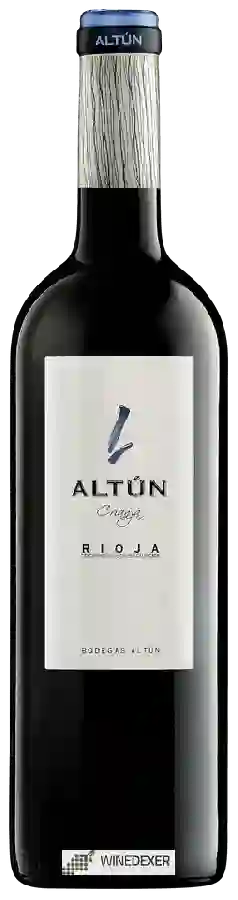
Winery AltúnCrianza
 Red wine



In the mouth this red wine is a powerful with a lot of tannins present in the mouth.
This wine generally goes well with poultry, beef or veal.
Taste structure of the Crianza from the Winery Altún
Light | Bold | |
Smooth | Tannic | |
Dry | Sweet | |
Soft | Acidic |
In the mouth the Crianza of Winery Altún in the region of Rioja is a powerful with a lot of tannins present in the mouth.
Wine flavors and olphactive analysis





On the nose the Crianza of Winery Altún in the region of Rioja often reveals types of flavors of non oak, earth or oak and sometimes also flavors of spices, red fruit or black fruit.
Food and wine pairings with Crianza
Pairings that work perfectly with Crianza



Original food and wine pairings with Crianza

The Crianza of Winery Altún matches generally quite well with dishes of beef, lamb or veal such as recipes of flemish beer stew, doner kebab or orloff roast.
Details and technical informations about Winery Altún's Crianza.
Discover the grape variety: Tempranillo
The black Tempranillo is a grape variety native to Spain. It produces a variety of grape specially used for the elaboration of wine. It is rare to find this grape to eat on our tables. This variety of grape is characterized by medium-sized bunches and medium-sized grapes. The black Tempranillo can be found in several vineyards: South-West, Languedoc & Roussillon, Cognac, Bordeaux, Rhone valley, Provence & Corsica, Loire valley, Savoie & Bugey, Beaujolais.
Last vintages of this wine
The best vintages of Crianza from Winery Altún are 2006, 2007, 2015, 2011 and 2009.
Informations about the Winery Altún
The Winery Altún is one of of the world's greatest estates. It offers 13 wines for sale in the of Rioja to come and discover on site or to buy online.

The wine region of Rioja
Rioja, in northern Spain, is best known for its berry-flavored, barrel-aged red wines made from Tempranillo and Garnacha. It is probably the leading wine region in Spain. It is certainly the most famous, rivaling only Jerez. The Vineyards follow the course of the Ebro for a hundred kilometres between the towns of Haro and Alfaro.
The word of the wine: Maceration
Prolonged contact and exchange between the juice and the grape solids, especially the skin. Not to be confused with the time of fermentation, which follows maceration. The juice becomes loaded with colouring matter and tannins, and acquires aromas. For a rosé, the maceration is short so that the colour does not "rise" too much. For white wines too, a "pellicular maceration" can be practised, which allows the wine to acquire more fat.