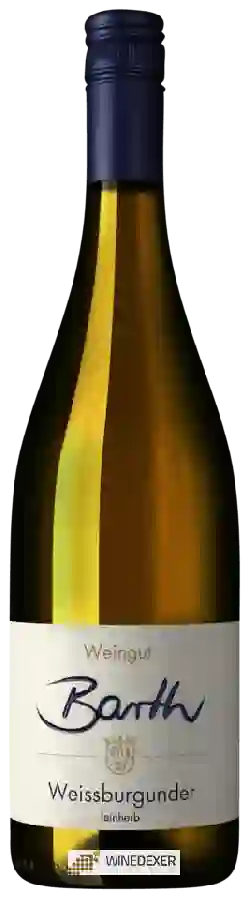
Weingut BarthWeissburgunder Feinherb
 White wine
In the mouth this white wine is a with a nice freshness.
This wine generally goes well with rich fish (salmon, tuna etc), shellfish or mild and soft cheese.
Taste structure of the Weissburgunder Feinherb from the Weingut Barth
Light | Bold | |
Dry | Sweet | |
Soft | Acidic |
In the mouth the Weissburgunder Feinherb of Weingut Barth in the region of Nahe is a with a nice freshness.
Food and wine pairings with Weissburgunder Feinherb
Pairings that work perfectly with Weissburgunder Feinherb



Original food and wine pairings with Weissburgunder Feinherb

The Weissburgunder Feinherb of Weingut Barth matches generally quite well with dishes of rich fish (salmon, tuna etc), shellfish or mild and soft cheese such as recipes of chinchards with white wine and grapes, traditional tunisian couscous or homemade burger.
Details and technical informations about Weingut Barth's Weissburgunder Feinherb.
Discover the grape variety: Herbemont
The origin of this American interspecific hybrid of the southern Vitis Aestivalis group, also called Vitis Bourquiniana, is not known for certain. In South Carolina (United States), it was propagated in the early 1800s by a Frenchman, Nicholas Herbemont (1771-1839), who found his first origins in Champagne. In France, it is one of six hybrids prohibited since 1935 (included in European regulations): Clinton, Herbemont, Isabelle, Jacquez, Noah and Othello. The Herbemont is very similar to the Jacquez - also called black spanish or lenoir - and has practically disappeared in favour of the latter.
Informations about the Weingut Barth
The Weingut Barth is one of of the world's greatest estates. It offers 23 wines for sale in the of Nahe to come and discover on site or to buy online.

The wine region of Nahe
Nahe is one of the smaller German wine regions, named after the Nahe river which joins the Rhein at Rheinhessen/bingen">Bingen. The viticultural carea here is characterised by dramatic topography with steep slopes and craggy outcrops of metamorphic rock. Like most of the regions on or near the Rhine, its most prestigious wines are made from Riesling. There are around 4,000 hectares (10,000 acres) of Vineyards, spread across seven Grosslagen (wine districts) and over 300 Einzellagen (individual vineyard sites).
The word of the wine: Phenolic ripeness
A distinction is made between the ripeness of sugars and acids and the ripeness of tannins and other compounds such as anthocyanins and tannins, which will bring structure and colour. Grapes can be measured at 13° potential without having reached this phenolic maturity. Vinified at this stage, they will give hard, astringent wines, without charm.