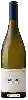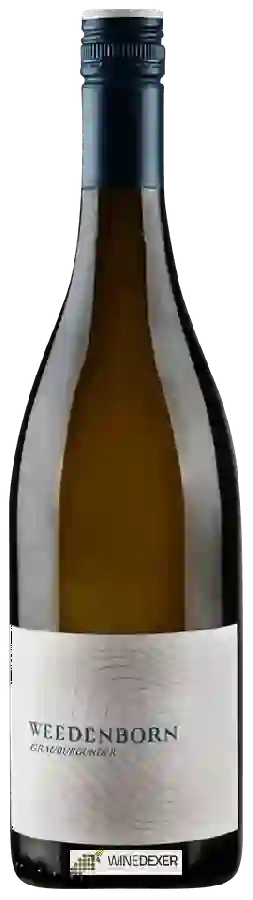
Winery WeedenbornGrauburgunder
 White wine



In the mouth this white wine is a powerful.
This wine generally goes well with pork, cured meat or mushrooms.
Taste structure of the Grauburgunder from the Winery Weedenborn
Light | Bold | |
Dry | Sweet | |
Soft | Acidic |
In the mouth the Grauburgunder of Winery Weedenborn in the region of Rheinhessen is a powerful.
Food and wine pairings with Grauburgunder
Pairings that work perfectly with Grauburgunder


Original food and wine pairings with Grauburgunder

The Grauburgunder of Winery Weedenborn matches generally quite well with dishes of pork, spicy food or mushrooms such as recipes of home-made white pudding, veal axoa (basque country) or risotto with ceps (italy).
Details and technical informations about Winery Weedenborn's Grauburgunder.
Discover the grape variety: Perle de Csaba
It is thought to have originated in Hungary, as Adolf Stark, a winegrower in Bekescsaba (Hungary), created it in 1904. According to genetic analyses, it is the result of a cross between the Madeleine angevine and the Muscat fleur d'oranger. The Csaba pearl has been used to obtain a few crosses (the red Csaba pearl is an example), the aim always being to try to find new varieties with early maturity. Today, it is only found in ornamental gardens, interesting only for its great earliness. Its many defects mean that it is almost on the verge of extinction, although it is included in the official catalogue of vine varieties on the A1 list.
Last vintages of this wine
The best vintages of Grauburgunder from Winery Weedenborn are 2018, 2016, 0, 2017 and 2015.
Informations about the Winery Weedenborn
The Winery Weedenborn is one of of the world's greatest estates. It offers 32 wines for sale in the of Rheinhessen to come and discover on site or to buy online.

The wine region of Rheinhessen
Rheinhessen is Germany's largest region for producing the quality wines of the Qualitätswein bestimmter Anbaugebiete (QbA) and Prädikatswein designations, with roughly 26,500 hectares (65,000 acres) of Vineyard">Vineyards as of 2014. Many of its most significant viticultural areas are favorably influenced by the Rhine river, which runs aLong its North and eastern borders. The Rhine, along with the Nahe river to the west and the Haardt mountains to its South, form a natural border. Rheinhessen covers an area south of Rheingau, north of Pfalz and east of Nahe, and is located within the Rhineland-Palatinate federal state.
The word of the wine: CM
Mention on the label of a champagne. It is a handling cooperative that produces on its own premises and markets under its own brand the wines made from the grapes harvested by its members.