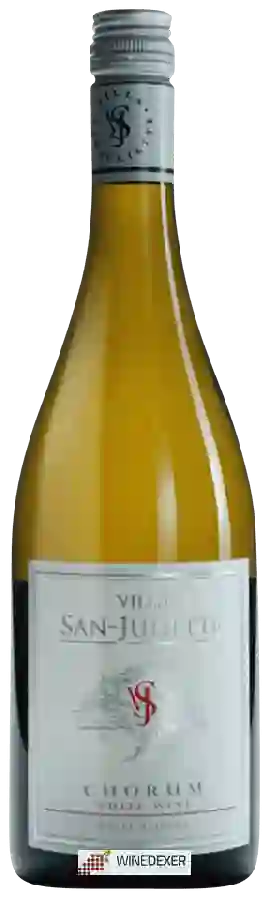
Winery Villa San-JulietteChorum White
 wine
wine
This wine generally goes well with
The Chorum White of the Winery Villa San-Juliette is in the top 0 of wines of Paso Robles.
Details and technical informations about Winery Villa San-Juliette's Chorum White.
Discover the grape variety: Black Monukka
A very old variety of table grape. It is believed to be a cross between the khourmany kizil or ichkimar and the sultana. In reality, the name Monukka covers several varieties - not all of which are apyrenic - that are somewhat similar and can be found in Armenia, Bulgaria, Slovakia, Moldavia, Italy, Uzbekistan, Afghanistan, Iran, South Africa, the United States (California), etc. In France, the black Monukka is practically not cultivated and is mainly of interest to amateur gardeners. - Synonyms: monucca in South Africa and the United States ..., monukka i siah in Afghanistan, black kischmish, kichmiche, kishmish chernyi, russian seedless, sultanina nera in Italy. This is not true because black sultanina does exist but it is very rare (for all the synonyms of the grape varieties, click here!)
Informations about the Winery Villa San-Juliette
The Winery Villa San-Juliette is one of of the world's great estates. It offers 21 wines for sale in the of Paso Robles to come and discover on site or to buy online.

The wine region of Paso Robles
The wine region of Paso Robles is located in the region of San Luis Obispo County of California of United States. We currently count 940 estates and châteaux in the of Paso Robles, producing 3510 different wines in conventional, organic and biodynamic agriculture. The wines of Paso Robles go well with generally quite well with dishes .
The wine region of California
California is the largest and most important wine region in the United States. It represents the southern two-thirds (850 miles or 1,370 kilometers) of the country's west coast. (Oregon and Washington make up the rest. ) The state also spans nearly 10 degrees of latitude.
The word of the wine: Old vines
There are no specific regulations governing the term "vieilles vignes". After 20 to 25 years, the yields stabilize and tend to decrease, the vines are deeply rooted, and the grapes that come from them give richer, more concentrated, more sappy wines, expressing with more nuance the characteristics of their terroir. It is possible to find plots of vines that claim to be a century old.