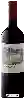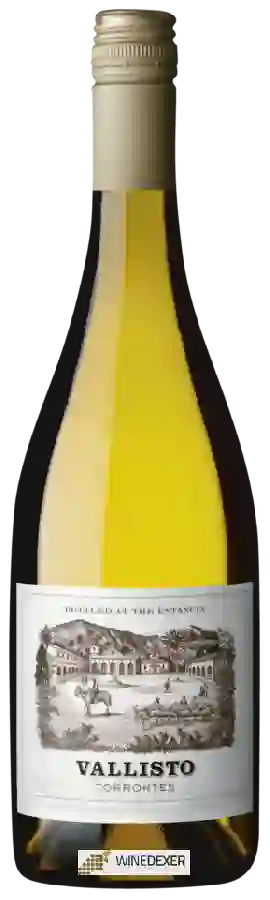
Winery VallistoTorrontes
 White wine



In the mouth this white wine is a powerful with a nice freshness.
This wine generally goes well with vegetarian, spicy food or aperitif.
Taste structure of the Torrontes from the Winery Vallisto
Light | Bold | |
Dry | Sweet | |
Soft | Acidic |
In the mouth the Torrontes of Winery Vallisto in the region of Salta is a powerful with a nice freshness.
Wine flavors and olphactive analysis





On the nose the Torrontes of Winery Vallisto in the region of Salta often reveals types of flavors of oak, tree fruit or spices and sometimes also flavors of citrus fruit, floral or tropical fruit.
Food and wine pairings with Torrontes
Pairings that work perfectly with Torrontes



Original food and wine pairings with Torrontes
The Torrontes of Winery Vallisto matches generally quite well with dishes of spicy food, vegetarian or aperitif such as recipes of chicken colombo, vegan leek and tofu quiche or brioche shuttles.
Details and technical informations about Winery Vallisto's Torrontes.
Discover the grape variety: Persan
Persan noir is a grape variety that originated in France (Savoie). It produces a variety of grape specially used for wine making. It is rare to find this grape to eat on our tables. This variety of grape is characterized by small bunches and small grapes. The Persan Noir can be found in several vineyards: South-West, Cognac, Bordeaux, Savoie & Bugey, Provence & Corsica, Rhone Valley, Loire Valley, Beaujolais.
Last vintages of this wine
The best vintages of Torrontes from Winery Vallisto are 2019, 2018, 2017, 0 and 2015.
Informations about the Winery Vallisto
The Winery Vallisto is one of of the world's greatest estates. It offers 7 wines for sale in the of Calchaqui Valley to come and discover on site or to buy online.

The wine region of Calchaqui Valley
Calchaqui Valleys is the most prolific wine region in Northern Argentina. It is also one of the highest anywhere in the world, with Vineyard altitudes ranging from 1500 to 3100 meters. As with other parts of the Country, Malbec is the key variety, supported by Cabernet Sauvignon and Torrontés. Merlot, Tannat, Cereza, Syrah, Bonarda and Moscatel (usually Muscat of Alexandria) are also grown.
The wine region of Salta
Salta, in the far North of Argentina, is home to some of the world's most extreme Vineyard sites. As is the case in Catamarca to the South and Jujuy to the northwest, Salta's vineyards are often located amid mountainous terrain with some reaching altitudes of just over 3,000 meters (9840ft) above sea level. The viticultural area is mainly concentrated to Cafayate of the Calchaqui Valley. Argentina's signature Grape varieties of Torrontes and Malbec are Salta's top performers, producing Bright, intensely flavored wines.
The word of the wine: Terroir
Strictly speaking, the notion of terroir corresponds to the geological characteristics of a vineyard. However, when we talk about terroir, we take into account the soil, the climate (even the microclimate), the flora, the fauna, and the human factor that characterizes the practices that make up the art of the craft.