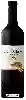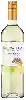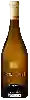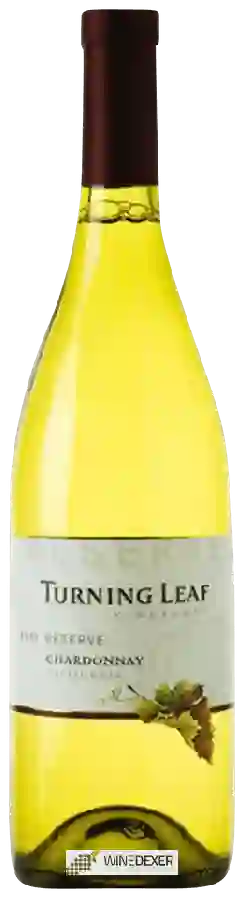
Winery Turning LeafReserve Chardonnay
 White wine


This wine is composed of 100% of the grape variety Chardonnay.
In the mouth this white wine is a powerful with a nice freshness.
This wine generally goes well with pork, vegetarian or poultry.

Taste structure of the Reserve Chardonnay from the Winery Turning Leaf
Light | Bold | |
Dry | Sweet | |
Soft | Acidic |
In the mouth the Reserve Chardonnay of Winery Turning Leaf in the region of California is a powerful with a nice freshness.
Food and wine pairings with Reserve Chardonnay
Pairings that work perfectly with Reserve Chardonnay



Original food and wine pairings with Reserve Chardonnay

The Reserve Chardonnay of Winery Turning Leaf matches generally quite well with dishes of pork, rich fish (salmon, tuna etc) or vegetarian such as recipes of ham croquette with purée, baked sea bream or magic cake cheese quiche.
Details and technical informations about Winery Turning Leaf's Reserve Chardonnay.
Discover the grape variety: Chardonnay
Whites with many faces: mineral and taut at Chablis (lemon, green apple, flint), opulent and buttery at Meursault and Puligny-Montrachet (hazelnut, brioche, yellow fruits), tense and chalky in Champagne (Blanc de Blancs). Also vinified sparkling and widely exported (Sonoma, Margaret River, Casablanca). A Burgundian variety, a cross of Pinot Noir × Gouais Blanc, half-sibling of Aligoté.
Last vintages of this wine
The best vintages of Reserve Chardonnay from Winery Turning Leaf are 0
Informations about the Winery Turning Leaf
The Winery Turning Leaf is one of of the world's great estates. It offers 33 wines for sale in the of California to come and discover on site or to buy online.

The wine region of California
Powerful, sunny reds: dense Napa Cabernet Sauvignon (blackcurrant, chocolate, tobacco, ample tannins), spicy, jammy Zinfandel from the Sierra Foothills, silky red-fruited Pinot Noir on the cool coast (Sonoma, Russian River, Central Coast). Opulent, buttery Chardonnay, notes of yellow fruit and vanilla. Varied climate, from the hot interior to the Pacific-cooled coast. 80% of US production, 139 AVAs including Napa (1st AVA, 1981).
The word of the wine: Oenologist
Specialist in wine-making techniques. It is a profession and not a passion: one can be an oenophile without being an oenologist (and the opposite too!). Formerly attached to the Faculty of Pharmacy, oenology studies have become independent and have their own university course. Learning to make wine requires a good chemical background but also, increasingly, a good knowledge of the plant. Some oenologists work in laboratories (analysis). Others, the consulting oenologists, work directly in the properties.