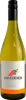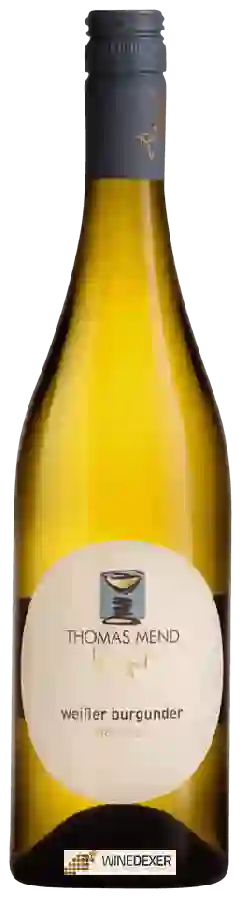
Winery Thomas MendWeissburgunder Trocken
 White wine
In the mouth this white wine is a powerful with a nice freshness.
This wine generally goes well with rich fish (salmon, tuna etc), shellfish or mild and soft cheese.

Taste structure of the Weissburgunder Trocken from the Winery Thomas Mend
Light | Bold | |
Dry | Sweet | |
Soft | Acidic |
In the mouth the Weissburgunder Trocken of Winery Thomas Mend in the region of Franken is a powerful with a nice freshness.
Food and wine pairings with Weissburgunder Trocken
Pairings that work perfectly with Weissburgunder Trocken



Original food and wine pairings with Weissburgunder Trocken

The Weissburgunder Trocken of Winery Thomas Mend matches generally quite well with dishes of rich fish (salmon, tuna etc), shellfish or mild and soft cheese such as recipes of penne with smoked salmon and crème fraiche, creamy risotto with scallops or north welsch.
Details and technical informations about Winery Thomas Mend's Weissburgunder Trocken.
Discover the grape variety: Vernaccia di Oristano
Long-aged oxidative and structured whites with an amber robe, a dense palate with fine acidity on bitter almond, dried fruits (walnut), saline and marked oxidative aromas (sherry style). Aged under a veil of flor in the manner of Andalusian fino. Star of the Vernaccia di Oristano DOC, a great traditional Sardinian oxidative wine. Vernaccia variety grown in Sardinia, in the Oristano region.
Informations about the Winery Thomas Mend
The Winery Thomas Mend is one of of the world's great estates. It offers 34 wines for sale in the of Franken to come and discover on site or to buy online.

The wine region of Franken
Homeland of German Silvaner: dry, straight, mineral and lively whites with notes of green apple, citrus, fresh herbs and a saline touch, planted here for over 350 years (1,500 ha, a quarter of the vineyard). Also supple, floral Müller-Thurgau, taut Riesling, aromatic Bacchus. Some discreet reds (Spätburgunder). 6,040 ha in Bavaria along the Main around Würzburg, red sandstone and shell-limestone soils.
The word of the wine: Varietal wine
Name given to the local wine (IGP), produced from a single grape variety that gives the wine its characteristics of structure and aroma. The Languedoc is the leading producer of this type of wine, from most of the major French grape varieties.