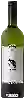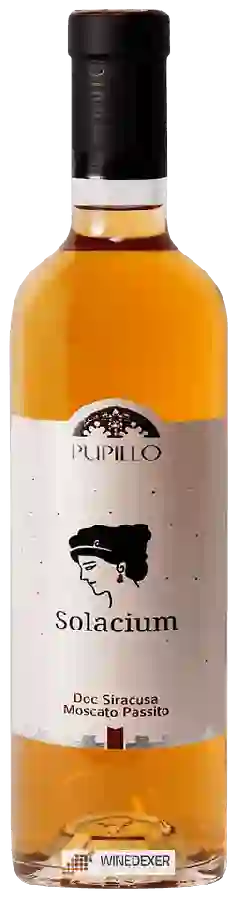
Winery PupilloSolacium Siracusa Moscato Passito
 Sweet wine


This wine generally goes well with
Wine flavors and olphactive analysis

On the nose the Solacium Siracusa Moscato Passito of Winery Pupillo in the region of Sicily often reveals types of flavors of tree fruit.
Details and technical informations about Winery Pupillo's Solacium Siracusa Moscato Passito.
Discover the grape variety: Précoce Bousquet
The Précoce Bousquet blanc is a grape variety that originated in France (Tarn). It produces a variety of grape specially used for wine making. It is rare to find this grape to eat on our tables. The Precoce Bousquet blanc can be found in several vineyards: South-West, Cognac, Bordeaux, Provence & Corsica, Rhone Valley, Loire Valley, Savoie & Bugey, Beaujolais.
Last vintages of this wine

The best vintages of Solacium Siracusa Moscato Passito from Winery Pupillo are 2011, 2015, 2014, 0 and 2017.
Informations about the Winery Pupillo
The Winery Pupillo is one of of the world's greatest estates. It offers 18 wines for sale in the of Moscato di Siracusa to come and discover on site or to buy online.

The wine region of Moscato di Siracusa
The wine region of Moscato di Siracusa is located in the region of Sicile of Italy. Wineries and vineyards like the Domaine Pupillo or the Domaine Pupillo produce mainly wines white, sweet and sparkling. On the nose of Moscato di Siracusa often reveals types of flavors of tree fruit. In the mouth of Moscato di Siracusa is a powerful.
The wine region of Sicily
Sicily is the Southernmost region of Italy, and the largest island in the Mediterranean Sea. For over 2500 years, Sicily (Sicilia in Italian) has been an important centre of Mediterranean viticulture, although the reputation and style of its wines have changed considerably over time. The island was once best known for its Sweet muscatels (see Pantelleria), and later for its fortified Marsala. Today, many of its best-known wines are Dry table wines produced under the regional designation IGT Terre Siciliane, or Sicilia DOC (see below).
The word of the wine: Cryo-extraction
This technique was very popular at the end of the 80's in Sauternes, a little less so now. The grapes are frozen before pressing, and the water transformed into ice remains in the marc, only the sugar flows out. As with the concentrators, the "cryo" can also increase bad taste and greenness.