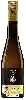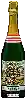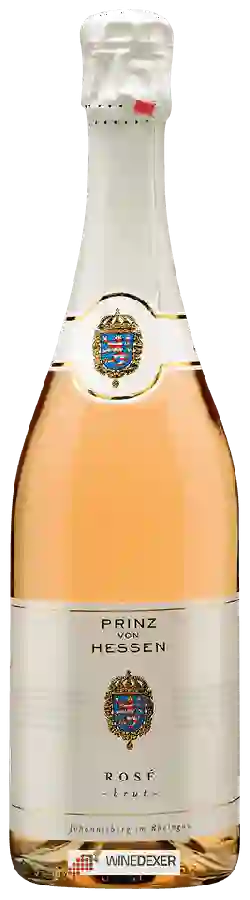
Winery Prinz von HessenRosé Brut
 Sparkling wine
This wine generally goes well with vegetarian

Food and wine pairings with Rosé Brut
Pairings that work perfectly with Rosé Brut

Original food and wine pairings with Rosé Brut
The Rosé Brut of Winery Prinz von Hessen matches generally quite well with dishes of vegetarian such as recipes of goat cheese and bacon quiche.
Details and technical informations about Winery Prinz von Hessen's Rosé Brut.
Discover the grape variety: Calabre blanc
Aromatic dry and semi-dry whites with a pale golden colour, a supple palate with moderate acidity, and characteristic muscat aromas (fresh grape, flowers) with Mediterranean notes. Simple profile. Nearly extinct in commercial cultivation, preserved in varietal collections; witnesses the historical spread of Italian varieties across central and eastern Europe. Historic Italian white variety, once grown in central and southern Italy and eastern Europe.
Informations about the Winery Prinz von Hessen
The Winery Prinz von Hessen is one of of the world's great estates. It offers 59 wines for sale in the of Johannisberg to come and discover on site or to buy online.

The wine region of Johannisberg
Historic village of the Rheingau (between Winkel and Geisenheim), worldwide birthplace of Riesling: Schloss Johannisberg was the first vineyard entirely planted with Riesling (~1720) and the first to vinify Spätlese in 1775. Riesling is the exclusive signature white: dry and mineral with citrus, white peach, apple, white flowers and a typical petrol note, vibrant acidity and slate depth. Four VDP Grosse Lage (Schloss Johannisberger, Klaus, Hölle, Mittelhölle).
The wine region of Rheingau
Historic cradle of great German Riesling: age-worthy whites of rare precision, from taut dry (Trocken) to botrytised sweet (Auslese, Beerenauslese, TBA) with notes of peach, citrus, acacia honey, noble petrol and slatey minerality. Riesling king on ~80% of the vineyard. Also Spätburgunder (Pinot Noir, 8%), notably the fine, silky Assmannshausen. 3,100 ha on south-facing slopes overlooking the Rhine (Hesse).
The word of the wine: Wine vinegar
Product of acetic fermentation of wine.